Snowflake
Poll Snowflake event tables and expose Snowflake SQL and Cortex as AgentField capabilities.
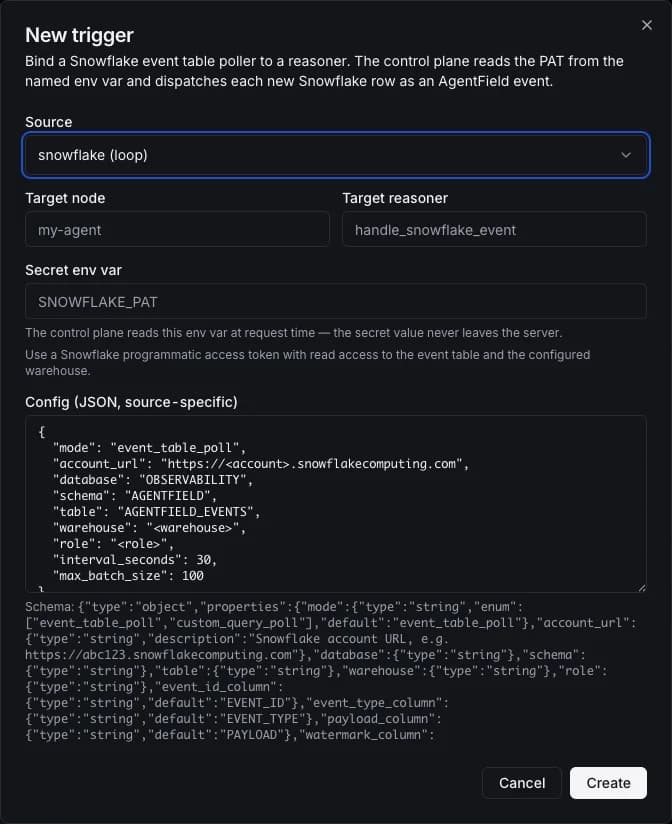
Snowflake has two OSS surfaces:
- A built-in control-plane source named
snowflakefor event-table or custom-query polling. - An optional deployable Snowflake node that exposes governed data capabilities through
app.call.
Trigger Source
Use event_table_poll when Snowflake alerts or tasks write rows into an AGENTFIELD_EVENTS table.
{
  "mode": "event_table_poll",
  "account_url": "https://<account>.snowflakecomputing.com",
  "database": "OBSERVABILITY",
  "schema": "AGENTFIELD",
  "table": "AGENTFIELD_EVENTS",
  "warehouse": "AGENTFIELD_WH",
  "role": "AGENTFIELD_ROLE",
  "interval_seconds": 30,
  "max_batch_size": 100
}
Set the trigger secret env var to a Snowflake programmatic access token, usually SNOWFLAKE_PAT. The secret value stays in the control-plane environment; trigger config stores only the env-var name.
The source also supports custom_query_poll for a read-only query that returns EVENT_ID, EVENT_TYPE, PAYLOAD, and OCCURRED_AT.
Event Table
CREATE TABLE IF NOT EXISTS AGENTFIELD_EVENTS (
  EVENT_ID STRING DEFAULT UUID_STRING(),
  EVENT_TYPE STRING NOT NULL,
  PAYLOAD VARIANT NOT NULL,
  OCCURRED_AT TIMESTAMP_LTZ DEFAULT CURRENT_TIMESTAMP(),
  CONSUMED_AT TIMESTAMP_LTZ
);
The source normalizes each row into an AgentField event and deduplicates by EVENT_ID.
Reasoners receive the normalized payload under event and dispatch metadata under _meta:
{
  "event": {
    "event_id": "evt_123",
    "event_type": "snowflake.alert.example",
    "occurred_at": "2026-06-15T10:30:00Z",
    "payload": { "source_table": "OBSERVABILITY.PUBLIC.REQUESTS" },
    "snowflake": {
      "account_url": "https://<account>.snowflakecomputing.com",
      "database": "OBSERVABILITY",
      "schema": "AGENTFIELD",
      "table": "AGENTFIELD_EVENTS",
      "query_id": "<statement-handle>"
    }
  },
  "_meta": {
    "source": "snowflake",
    "event_type": "snowflake.alert.example",
    "idempotency_key": "evt_123"
  }
}
Capability Node
Deploy the optional node when agents need to query Snowflake or call Cortex from other AgentField nodes.
The OSS package is in integrations/snowflake. The node image is built from integrations/snowflake/node/Dockerfile, which expects the repository root as the Docker build context; the package also includes a docker-compose.example.yml.
git clone https://github.com/Agent-Field/agentfield.git
cd agentfield
docker build \
  -f integrations/snowflake/node/Dockerfile \
  -t agentfield-snowflake-node:latest \
  .
docker run --name agentfield-snowflake \
-p 8012:8012 \
-e AGENTFIELD_SERVER=http://host.docker.internal:8080 \
-e AGENTFIELD_NODE_ID=snowflake-prod \
-e SNOWFLAKE_NODE_PUBLIC_URL=http://localhost:8012 \
-e SNOWFLAKE_ACCOUNT_URL=https://<account>.snowflakecomputing.com \
-e SNOWFLAKE_PAT=<programmatic-access-token> \
-e SNOWFLAKE_DATABASE=OBSERVABILITY \
-e SNOWFLAKE_SCHEMA=AGENTFIELD \
-e SNOWFLAKE_WAREHOUSE=AGENTFIELD_WH \
agentfield-snowflake-node:latestCall it from any SDK:
result = await app.call("snowflake-prod.semantic_ask", input={
    "question": "What changed in revenue yesterday?"
})
const result = await ctx.call('snowflake-prod.semantic_ask', {
question: 'What changed in revenue yesterday?',
});result, err := a.Call(ctx, "snowflake-prod.semantic_ask", map[string]any{
"question": "What changed in revenue yesterday?",
})The node registers these callable reasoners. Their descriptions come from the OSS package manifest and node registration code.
| Capability | Description | Input | Output |
|---|---|---|---|
health | Report Snowflake node configuration health. | {} | status, node_id, prompt source/version, default Cortex model, Snowflake defaults. |
query_readonly | Run a guarded read-only Snowflake SQL statement. | sql; optional database, schema, warehouse, role, max_rows, timeout_seconds. | query_id, columns, rows, row_count, truncated, provenance. |
describe_table | Describe a Snowflake table or view. | object or table. | Query-style table metadata rows plus provenance. |
search_columns | Search Snowflake INFORMATION_SCHEMA columns. | query; optional database, schema, limit. | Matching column rows plus query provenance. |
cortex_analyst_message | Call Snowflake Cortex Analyst. | question; optional semantic_model, semantic_model_file, semantic_view, conversation. | answer, raw response, snowflake_request_id. |
cortex_search_query | Query a Cortex Search service. | service, query; optional database, schema, columns, filter, limit. | results, raw response, service name, snowflake_request_id. |
cortex_complete | Call Snowflake Cortex model inference. | model, prompt; optional system, max_tokens, temperature. | text, model, snowflake_request_id, optional usage. |
semantic_ask | Answer a data question using semantic context and configured prompts. | question; optional semantic model/view/context or model. | answer, model/query id when used, prompt source/keys, or NEEDS_REVIEW. |
explain_result | Explain a query result with configured caveat policy. | result or result_preview; optional question, model. | answer, model/query id, prompt source, or NEEDS_REVIEW. |
investigate_metric_change | Plan a bounded metric-change investigation. | metric_name, time_window. | status, rendered prompt, recommended follow-up calls, prompt source. |
Typical DX is to let an event trigger a domain reasoner, then call the Snowflake node only for data work:
@app.reasoner()
async def investigate_snowflake_alert(input: dict):
    event = input["event"]
    answer = await app.call("snowflake-prod.semantic_ask", input={
        "question": f"Explain {event['event_type']} with the latest warehouse context",
        "semantic_model": "finance_metrics",
    })
return {"event_id": event["event_id"], "analysis": answer}agent.reasoner('investigateSnowflakeAlert', async (ctx) => {
const { event } = ctx.input;
const answer = await ctx.call('snowflake-prod.semantic_ask', {
question: `Explain ${event.event_type} with the latest warehouse context`,
semantic_model: 'finance_metrics',
});
return { event_id: event.event_id, analysis: answer };
});a.RegisterReasoner("investigate_snowflake_alert", func(ctx context.Context, input map[string]any) (any, error) {
event, _ := input["event"].(map[string]any)
eventID, _ := event["event_id"].(string)
eventType, _ := event["event_type"].(string)
answer, err := a.Call(ctx, "snowflake-prod.semantic_ask", map[string]any{
"question": fmt.Sprintf("Explain %s with the latest warehouse context", eventType),
"semantic_model": "finance_metrics",
})
if err != nil {
return nil, err
}
return map[string]any{"event_id": eventID, "analysis": answer}, nil
})Guardrails
- Default SQL capability is read-only.
- DDL, DML,
COPY,CALL,PUT,GET, and role switching are denied by default. - Prompt-backed reasoners load prompts from
SNOWFLAKE_PROMPTS_FILEor packaged defaults, not hardcoded customer behavior.