Production capabilities
The backend capabilities AgentField gives agent systems out of the box.
AgentField gives agent systems the backend capabilities they need once they move past a demo: APIs, routing, memory, triggers, approvals, rollouts, IAM, audit, observability, and SDKs.
The point is not a longer feature list. The point is that these capabilities come from one operating model instead of a pile of queues, wrappers, databases, cron jobs, dashboards, and policy checks you assemble yourself.
Agent logic becomes backend infrastructure.
Agent APIs
Turn agent logic into callable backend capabilities with one target format:
<node_id>.<reasoner_or_skill>Every caller uses the same shape whether it calls over HTTP, through an SDK, or from another agent:
POST /api/v1/execute/pricing.quote_enterprise_plan
POST /api/v1/execute/security.triage_alert
POST /api/v1/execute/approvals.review_large_refund
POST /api/v1/execute/vendor_risk.review_vendor
Inside an agent, the same target is used through app.call:
risk = await app.call("risk.score_claim", claim=claim)
approval = await app.call("approvals.review_large_refund", refund=refund)
const risk = await ctx.call('risk.score_claim', { claim });
const approval = await ctx.call('approvals.review_large_refund', { refund });risk, err := a.Call(ctx, "risk.score_claim", map[string]any{"claim": claim})
approval, err := a.Call(ctx, "approvals.review_large_refund", map[string]any{"refund": refund})| Capability | What it lets you do |
|---|---|
| Agents | Package reasoners and skills as deployable service nodes. |
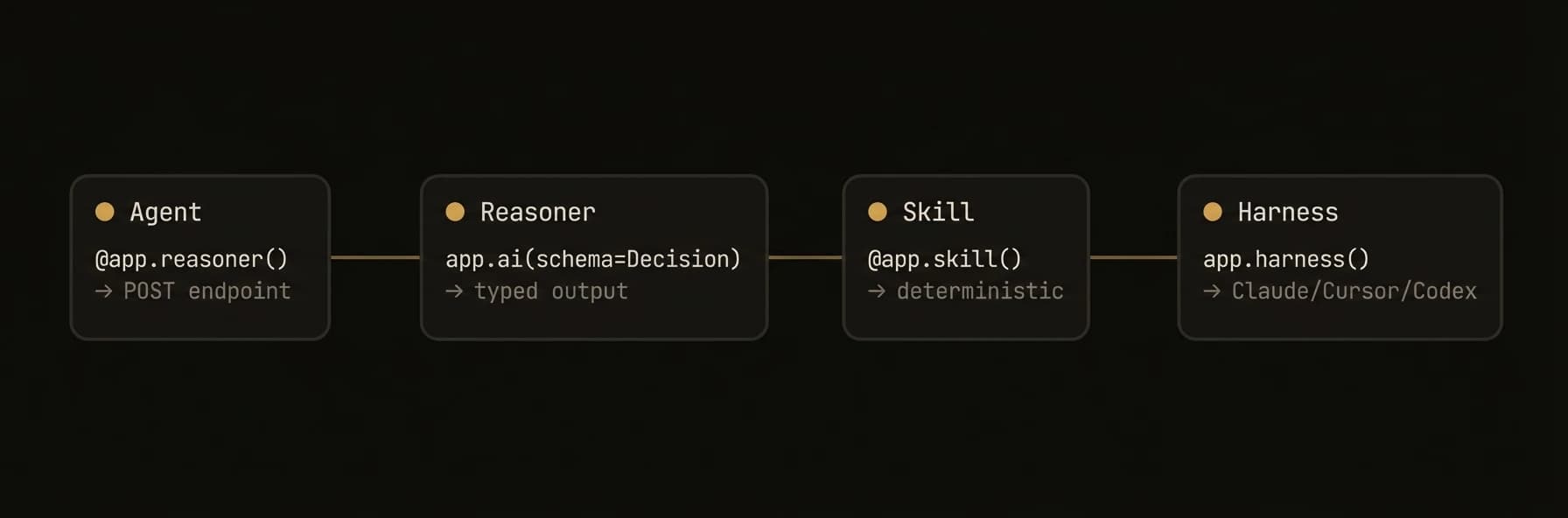
| Reasoners | Expose LLM-backed decisions as typed, tracked endpoints. |
| Skills | Give agents deterministic tools: API calls, calculations, file operations, and database reads. |
| Uniform execution API | Call any reasoner or skill through the control plane with the same target format. |
| Typed inputs and outputs | Treat agent calls like backend contracts, not prompt strings. |
Agent Services
Agent nodes deploy separately even when they call each other. That is the microservice-shaped part of AgentField: each agent owns a capability, registers with the control plane, and can scale or change independently.
| Capability | What it lets you do |
|---|---|
| Independent agent nodes | Run pricing, risk, approvals, research, and support agents as separate processes or services. |
| Control-plane routing | Keep routing, policy, tracing, and audit consistent across node boundaries. |
| Cross-agent calls | Compose services with app.call("node.function") instead of custom HTTP clients. |
| Versioned lifecycle | Track readiness, health, leases, graceful shutdown, and version metadata. |
| Language boundaries | Let a TypeScript product agent call a Python model agent or Go platform agent through the same target shape. |
This is the core architecture idea: agents are not buried inside one app. They are independently deployed backend capabilities that can talk to each other with a simple node.function target, while AgentField handles the routing, policy checks, traces, and execution records around the call.
Agent Discovery
Make the network discoverable instead of wiring every call by hand.
| Capability | What it lets you do |
|---|---|
| Agent discovery | Query the live registry by tag, health, or capability. |
| External agent discovery | Extend discovery beyond your control plane by publishing selected capabilities through /.well-known/ai-catalog.json. |
| Tool calling | Let a model discover available agent capabilities and call the right one. |
| Filtered tool exposure | Expose only specific tags or capability groups to an LLM. |
| Schema-aware calls | Hydrate input schemas so models and callers know what a function expects. |
| Dynamic routing | Route to healthy, matching capabilities instead of hardcoded service URLs. |
Agent Traffic
Run agents the way backend engineers run services: many calls, long jobs, retries, webhooks, and visible execution state.
| Capability | What it lets you do |
|---|---|
| Async execution | Queue long-running work and return an execution ID immediately. |
| Realtime sessions | Start live voice or multimodal interactions through the control plane, then route tools into normal reasoner workflows. |
| Webhooks | Push completion events to your systems with HMAC verification. |
| Streaming | Send live execution, node, and memory events to UIs and operators. |
| Workflow DAGs | See every child call, duration, retry, and result in the execution graph. |
| Fair scheduling | Keep one busy agent from starving the rest of the system. |
This is the difference between "the agent ran" and "the agent is part of production traffic."
Realtime Sessions
Sessions extend the same backend model to live interactions. A browser voice call starts an AgentField session, exchanges realtime setup through the control plane, and invokes reasoner tools with the session ID attached.
| Capability | What it lets you do |
|---|---|
| Session declarations | Register realtime or multimodal entrypoints beside reasoners and skills. |
| WebRTC voice guide | Build browser audio calls without putting provider keys in the browser. |
| Session-scoped workflows | Keep voice-triggered reasoner work visible in the normal workflow DAG. |
| Explicit provider and transport | Validate provider and transport without inferring or switching providers behind the caller. |
Triggers
Agents should not only run when a user clicks a button. They should react to the systems around them.
| Capability | What it lets you do |
|---|---|
| Webhook triggers | Start agents from GitHub, Stripe, Slack, Linear, Sentry, HubSpot, PagerDuty, or custom events. |
| Memory triggers | Fire a reasoner when important state changes. |
| Schedules | Run background checks, syncs, and reviews on cron-style intervals. |
| Replay safety | Verify signatures, reject replays, and route events with idempotency keys. |
| Observability forwarding | Send platform events to Datadog, Splunk, or your own collector. |
That turns agents into reactive backend workers, not only request-response handlers.
Safe Rollouts
Reasoning changes are production changes. They need rollout patterns, human gates, and clear lifecycle boundaries.
| Capability | What it lets you do |
|---|---|
| Human approval | Pause execution for a human decision, then resume without losing state. |
| A/B and canary-style deployments | Run variants as separate agents, route traffic intentionally, and compare outcomes through the workflow DAG. |
| Versioning and lifecycle | Track versions, health, readiness, leases, and graceful shutdown. |
| Policy checks | Control which agents may call which capabilities before execution starts. |
| Harness turn caps | Dispatch a coding agent — AForge by default, or Claude Code, Codex, Gemini, or OpenCode — with structured output, turn caps (and a USD cost cap on Claude Code), and failure metadata. |
AgentField does not ask you to treat a new prompt, model, or workflow as a blind deploy.
Agent IAM
AI backends need identity and authorization the same way service backends do. The difference is that the caller may be another agent, the target may be a tool, and the decision may need to be proven later.
| Capability | What it lets you do |
|---|---|
| Agent identity | Give every agent and function a cryptographic identity. |
| Access control | Allow or deny cross-agent calls by tags, functions, and input constraints. |
| External import callability | Keep outside-network discovery separate from which imported resources may be called through AgentField. |
| Outbound API identity | Replace shared API keys with signed requests from agent identities. |
| Policy | Enforce authorization at the runtime boundary. |
| Permissions | Keep tool access explicit as agents compose into larger systems. |
The implementation uses DIDs and signed credentials under the hood, but the product idea is simpler: agents get first-class IAM.
Cryptographic Proof
When agents make decisions, logs are not enough. AgentField can produce verifiable records of what ran, who ran it, and how a workflow evolved.
| Capability | What it lets you do |
|---|---|
| Cryptographic receipts | Produce signed, offline-verifiable records for AI decisions. |
| Signed audit chains | Export every step of a workflow as an ordered, verifiable chain. |
| Audit trails | Attach notes, correlation IDs, metrics, and structured logs to executions. |
| Workflow provenance | Trace multi-agent work across calls, tools, approvals, and retries. |
| Offline verification | Verify records outside the running control plane. |
This is one of the biggest differences between an agent app and an AI backend: the backend needs to prove what happened.
Intelligence
AgentField still gives you the core agent-building pieces. They just live inside the backend runtime.
| Capability | What it lets you do |
|---|---|
| 100+ models | Use OpenAI, Anthropic, Google, Mistral, Cohere, and open-source models through one surface. |
| Structured output | Return validated Pydantic, Zod, or Go structs instead of parsed strings. |
| Shared memory | Coordinate agents through scoped key-value and vector state. |
| Multimodal agents | Accept images and audio, and generate image, audio, video, or music outputs. |
| Realtime voice sessions | Carry live audio interactions through AgentField while preserving workflow provenance. |
| Harness orchestration | Run a coding agent as part of an agent workflow. AForge ships with af and runs by default; Claude Code, Codex, Gemini CLI, and OpenCode are one field away. |
You still get planning, tool use, structured model calls, memory, and orchestration. The difference is that they are wrapped in production controls.
SDK Surfaces
AgentField is meant for real stacks, not one-language demos.
| Surface | Use it for |
|---|---|
| Python | AI-heavy services, data workflows, and fast iteration. |
| TypeScript | Product apps, web backends, workers, and integrations. |
| Go | Platform services and high-concurrency backend agents. |
| REST | Calling and inspecting agents from any service. |
| CLI | Local development, operations, automation, and agent-friendly JSON output. |
Deployment stays backend-shaped too: local dev, Docker, PostgreSQL, Kubernetes, and cloud platforms are covered in the deployment guide.
What This Replaces
If you build this around a framework yourself, you usually end up owning:
| You would build | AgentField gives you |
|---|---|
| HTTP wrappers around every agent function | Agent APIs |
| Service registry and routing glue | Discovery and node.function targets |
| Cross-service HTTP clients | app.call("node.function") through the control plane |
| Queue, retry, polling, and webhook workers | Durable execution |
| Cron jobs and event listeners | Triggers |
| Redis, vector DB, and pub-sub plumbing | Shared memory and memory events |
| Manual approval systems | Human-in-the-loop execution |
| Agent-to-agent auth rules | Agent IAM |
| Logs, traces, and custom audit exports | DAGs, receipts, and audit chains |
Next: Quickstart to run it, or Building Blocks to see the implementation model.