Writing
Essays and field notes on AI backends, harness orchestration, and what breaks when agents reach production.
33 entries · since 2026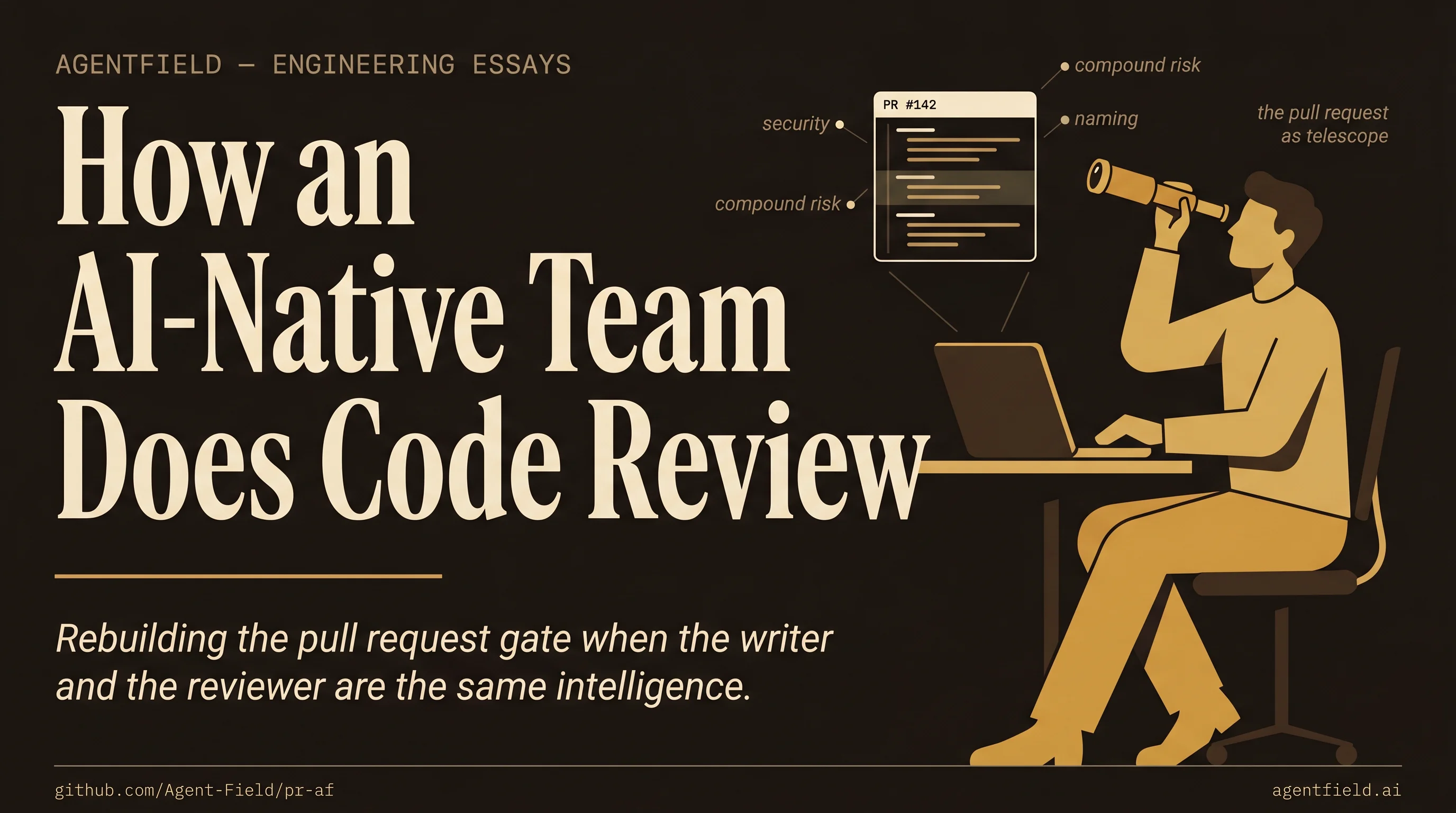 How an AI-Native Engineering Team Does Code ReviewWhen the writer and the reviewer are the same intelligence, the pull request gate stops doing what it was designed to do. We rebuilt code review at AgentField from the ground up — what changed, why, and what we open-sourced.Read
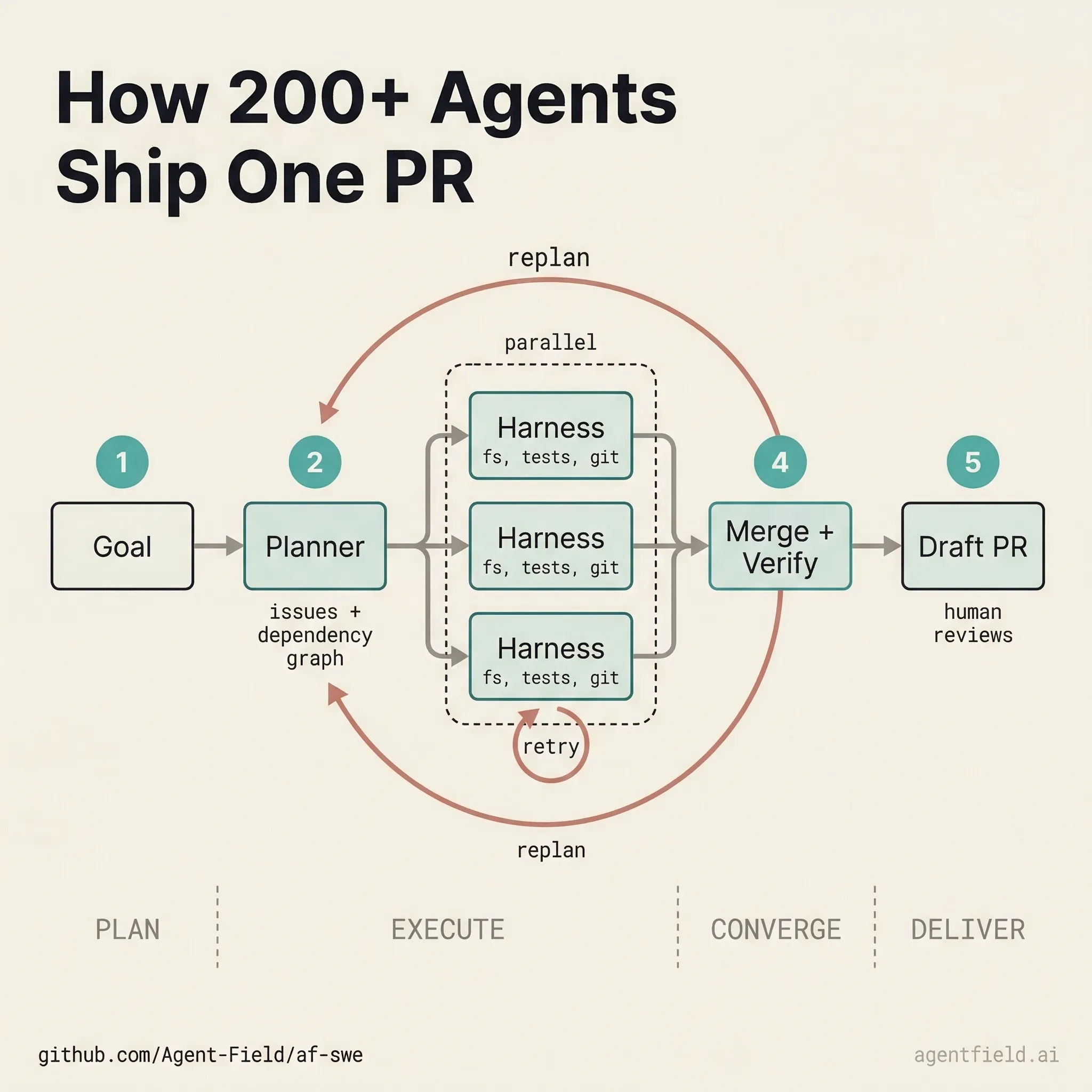
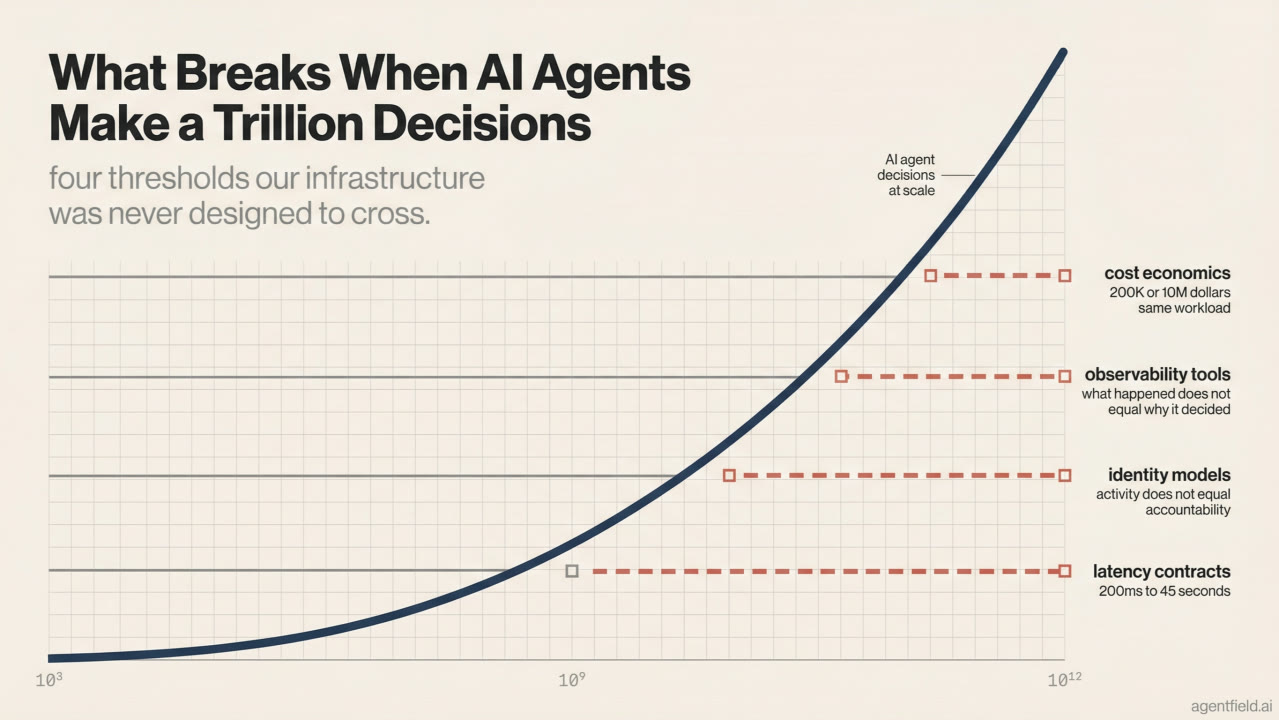
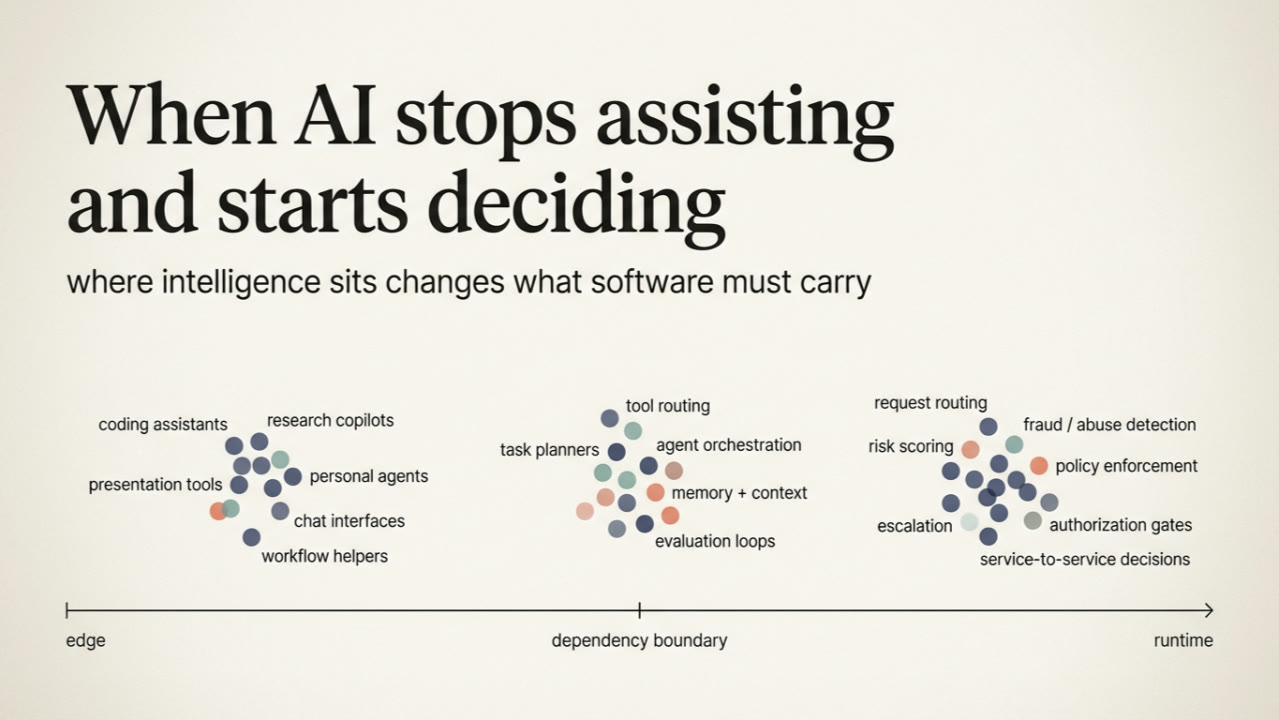
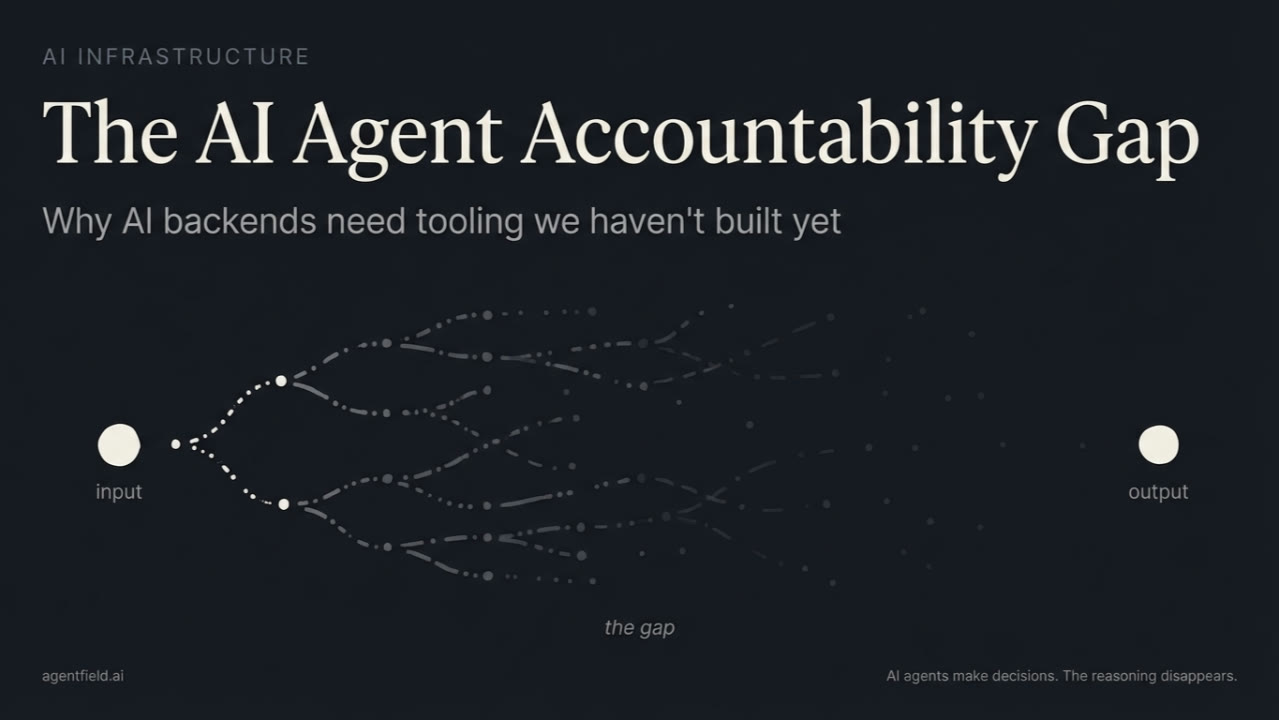
jul 2026Your personal control planeRun AgentField in local mode on your own laptop or homelab, register one agent, and call it over HTTP. This is the substrate the rest of the personal stack builds on.4 minjul 2026Thinking in reasonersThe capstone mental model for the personal stack. Five habits that turn a pile of prompts into a system, each shown as a small before and after, with the one table you need for deciding between app.ai and app.harness.6 minjul 2026Simulate a market with 200 agentsA market simulation where 200 trader reasoners read a shared order book from global memory, decide with a cheap model, and post orders back every round, while an orchestrator fans them out and code clears the price, all watchable live in the dashboard DAG.6 minjul 2026The deployment that promotes itselfA self-tuning rollout deploys a new agent version at a small traffic weight, then an operator agent polls per-version failure rates and shifts weight itself, promoting on wins and rolling back on regressions.5 minjul 2026Agents that wake up when data changesDeclare @app.memory.on_change("order_*") and a handler fires whenever a matching key changes, written by any agent, in any scope. No cron, no broker, no consumer groups.5 minjul 2026Pipelines that build themselvesAn intake reasoner reads the input, decides which analysis dimensions it actually needs, then the orchestrator spawns exactly those specialists with prompts written at runtime, so the pipeline shape is a trace of what happened rather than a graph declared upfront.5 minjul 2026One control plane for XGBoost and agentsWrap a trained XGBoost model as a skill, serve 95% of traffic in milliseconds, and cascade the low-confidence remainder to a reasoner. Same tracing, same DAG, one ops story.5 minjul 2026A nightly maintenance fleet for your reposOne scheduled reasoner that clones your repos at 3am, runs a budget-capped coding agent on each, and leaves a morning summary and a stack of ready PRs behind an approval gate.7 minjul 2026From LangGraph prototype to productionThe mechanical path from a LangGraph StateGraph that works in a notebook to reasoners other services can call, retry, and run for 40 minutes.5 minjul 2026Human approval gates in 20 linesSuspend a running agent on a low-confidence decision, notify a reviewer, and resume exactly where it stopped. The wait state lives in the control plane, so it survives restarts.5 minjul 2026Fan out 1,000 parallel agents from one requestA recursive reasoner that decomposes a question and calls itself in parallel through the control plane, depth-capped, with queueing and tracing handled for you.4 minjul 2026A fleet of coding agents with budget capsRun N coding agents in parallel as one governed fleet. Each gets its own checkout, a dollar cap, a turn limit, and a tool allowlist, and you get back one cost table.5 minjul 2026Claude Code as a functionCall a multi-turn coding agent like Claude Code from your backend with a dollar budget cap, a turn limit, restricted tools, and typed output.4 minjul 2026Build your own personal assistantA reasoner with per-chat memory that reaches your other agents, plus a 70-line Telegram bridge you own. Text your personal stack from your phone.5 minjul 2026Approve your agents from your phoneNotify yourself when an agent pauses, then approve or reject it with one tap from a lock screen. A five-line notify plus a twenty-line signed handler turns any pause into a phone gate.7 minjul 2026An agent that ships new versions of itselfA self-improvement loop where a production agent records its own failures to memory, an improver agent reads them and writes a revised prompt, and that prompt ships as a new version the self-tuning rollout then canaries behind a human gate.5 minjul 2026Agents that run for three daysFire an agent with one POST, close the connection, and get a signed webhook when it finishes hours or days later, backed by a durable PostgreSQL queue with retries.4 minjul 2026The agent that finds its own toolsA reasoner that calls app.ai(tools="discover") sees every capability registered on the mesh at call time and invokes what it needs, so deploying a new agent tonight makes it callable by tomorrow with zero redeploys.5 minjul 2026Agents that debug agentsA workflow fails at 2am. Instead of a human paging through logs, an operator agent fetches the failed DAG, diagnoses the root cause, and drafts a fix behind an approval gate while you sleep.6 minjul 2026Add an agent mesh to your existing FastAPI or Next.js appDeploy a reasoning agent as a sidecar service and call it over REST from the app you already have. No framework adoption, no rewrite.3 minjul 2026How we ran a 250-agent security audit for 90 centsA full security audit that runs 166 to 255 agent calls and confirms 28 exploitable findings costs between 18 and 90 cents, because each call is small, routed to the right model, and capped.5 minjun 2026Capabilities You Do Not OwnTwenty years of integration have run on copying data across a boundary. Agentic consumers make that trade worse. Agentic Resource Discovery is the visible half of the response. The runtime layer that has to sit beneath it is the harder half, and data platforms are the most natural place to see it land.9 minmay 2026The Hidden Primitive Behind Claude Code, Codex, and GeminiPart 2 of the harness orchestration series. Four properties of the boundary surface of a single harness: the workspace it reads at startup, the boundary that drifts while it runs, the verifiers it can and cannot see, and the blast radius the team can afford to undo.10 minapr 2026An Engineer's Guide to Harness OrchestrationWhy orchestration changes when the unit decides for itself. The harness is a fundamentally new kind of computational object, defined by agency, embodiment, and persistence in one primitive. Part 1: The Black Box.13 minapr 2026What is harness orchestration?What changes when the atomic unit of intelligence is no longer an API call, or no longer a single LLM call. From invoking one model to orchestrating teams of autonomous harnesses like Claude Code, Cursor, Codex, Gemini, and the systems built above them.12 minmar 2026Beyond Vibe Coding: How We Ship Production Code with 200 Autonomous AgentsWhat we learned orchestrating 200+ Claude Code instances on a shared codebase: two LLM primitives, three nested failure loops, and checkpoint-based execution.15 minfeb 2026What Breaks When AI Makes a Trillion DecisionsThe world makes hundreds of billions of API calls every day. Each call carries a decision. Most of these decisions are hardcoded into configuration files and compiled binaries. But that's starting to change, and the infrastructure isn't ready.8 minjan 2026A Useful Way to Think About Where AI Fits in SoftwareThe speed at which agent-style systems have moved from research to daily use has been remarkable, even as their impact inside real business environments remains uneven. A clearer split begins to appear when you look at where intelligence sits in the architecture.8 minjan 2026The AI Agent Accountability GapWhy AI backends need tooling we haven't built yet. When a returns agent approved a $12,000 refund it shouldn't have, nothing looked wrong. The logs showed no errors, every validation check passed. The problem was that no one could explain why it made that call.9 mindec 2024The Move from Monolithic AI to Modular SystemsWhat a documentation chatbot taught us about building AI features that scale. When web applications hit complexity, we extracted microservices. The same evolution is happening with AI.7 mindec 2024IAM for AI BackendsHow DIDs and Verifiable Credentials enable trust for AI agents13 mindec 2024The AI BackendFive years from now, every serious software company will have an AI backend - a reasoning layer that sits alongside their services, making decisions that used to be hardcoded.6 min