BuildBuilding Blocks
Agents
The core container that hosts reasoners, skills, and sessions, and connects to the AgentField control plane
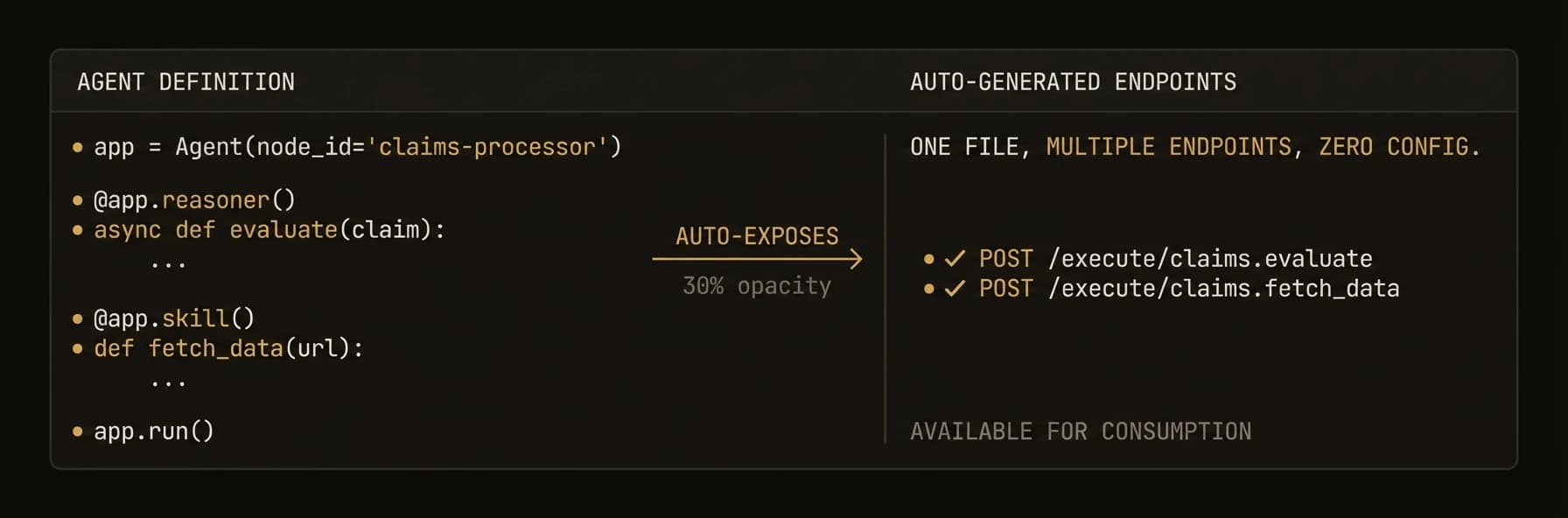
The top-level container that turns your code into a discoverable, governed, production microservice. An Agent instance hosts reasoners, skills, and sessions, and registers them with the control plane.
Without Agent, you would wire an HTTP server, registration, routing, identity, tracing, memory access, and cross-agent calls separately. With Agent, that infrastructure boundary is the object you instantiate.
from agentfield import Agent, AIConfig
from pydantic import BaseModel

app = Agent(
    node_id="support-triage",                                    # unique ID in the network
    ai_config=AIConfig(model="anthropic/claude-sonnet-4-20250514"),
)

class TicketClassification(BaseModel):
    priority: str      # "critical" | "high" | "normal" | "low"
    department: str    # route to the right team
    summary: str       # one-line summary for the queue

@app.reasoner()  # AI-powered — gets an LLM client automatically
async def classify_ticket(subject: str, body: str, customer_id: str) -> TicketClassification:
    result = await app.ai(
        system="You triage customer support tickets.",
        user=f"Subject: {subject}\n\n{body}",
        schema=TicketClassification,  # validated, typed output
    )
    await app.memory.set(f"ticket:{customer_id}:last_priority", result.priority)
    return result

@app.skill()  # deterministic — no AI, just business logic
def escalation_policy(priority: str) -> dict:
    sla = {"critical": 15, "high": 60, "normal": 240, "low": 1440}
    return {"sla_minutes": sla.get(priority, 240)}

app.run()  # starts HTTP server + registers with control plane
# POST /reasoners/classify_ticket  →  AI classification
# POST /skills/escalation_policy   →  SLA lookup
import { Agent } from '@agentfield/sdk';
import { z } from 'zod';
const agent = new Agent({
nodeId: 'support-triage', // unique ID in the network
aiConfig: { provider: 'anthropic', model: 'claude-sonnet-4-20250514' },
});
const TicketClassification = z.object({
priority: z.enum(['critical', 'high', 'normal', 'low']),
department: z.string(), // route to the right team
summary: z.string(), // one-line summary for the queue
});
agent.reasoner('classifyTicket', async (ctx) => { // AI-powered
const result = await ctx.ai(
`Subject: ${ctx.input.subject}\n\n${ctx.input.body}`,
{
system: 'You triage customer support tickets.',
schema: TicketClassification, // validated, typed output
},
);
await ctx.memory.set(`ticket:${ctx.input.customerId}:lastPriority`, result.priority);
return result;
});
agent.skill('escalationPolicy', (ctx) => { // deterministic — no AI
const sla: Record<string, number> = { critical: 15, high: 60, normal: 240, low: 1440 };
return { slaMinutes: sla[ctx.input.priority] ?? 240 };
});
agent.serve(); // starts HTTP server + registers with control planepackage main
import (
"context"
"log"
"github.com/Agent-Field/agentfield/sdk/go/agent"
"github.com/Agent-Field/agentfield/sdk/go/ai"
)
func main() {
a, _ := agent.New(agent.Config{
NodeID: "support-triage", // unique ID in the network
Version: "1.0.0",
AgentFieldURL: "http://localhost:8080",
AIConfig: &ai.Config{Model: "anthropic/claude-sonnet-4-20250514"},
})
// AI-powered — gets an LLM client automatically
a.RegisterReasoner("classify_ticket", func(ctx context.Context, input map[string]any) (any, error) {
subject, _ := input["subject"].(string)
body, _ := input["body"].(string)
return map[string]any{"priority": "high", "department": "billing", "summary": subject}, nil
})
// Deterministic — no AI, just business logic
a.RegisterReasoner("escalation_policy", func(ctx context.Context, input map[string]any) (any, error) {
sla := map[string]int{"critical": 15, "high": 60, "normal": 240, "low": 1440}
priority, _ := input["priority"].(string)
return map[string]any{"sla_minutes": sla[priority]}, nil
})
log.Fatal(a.Run(context.Background())) // starts HTTP server + registers with control plane
}What just happened
- One
Agentinstance exposed both AI and deterministic operations - The reasoner got model access, validation, and workflow context automatically
- The deterministic function became a separate callable endpoint without extra server code
- In all three SDKs, deterministic endpoints can be registered separately from AI-powered reasoners
- The memory write used the same execution context as the reasoner
Example generated surface:
Python/TypeScript:
POST /reasoners/classify_ticket
POST /skills/escalation_policy
target: support-triage.classify_ticket

Go equivalent:
POST /reasoners/classify_ticket
POST /skills/escalation_policy