BuildIntelligence
Media Generation
Generate images, video, audio, and music with a unified API backed by pluggable media providers across Python, TypeScript, and Go.
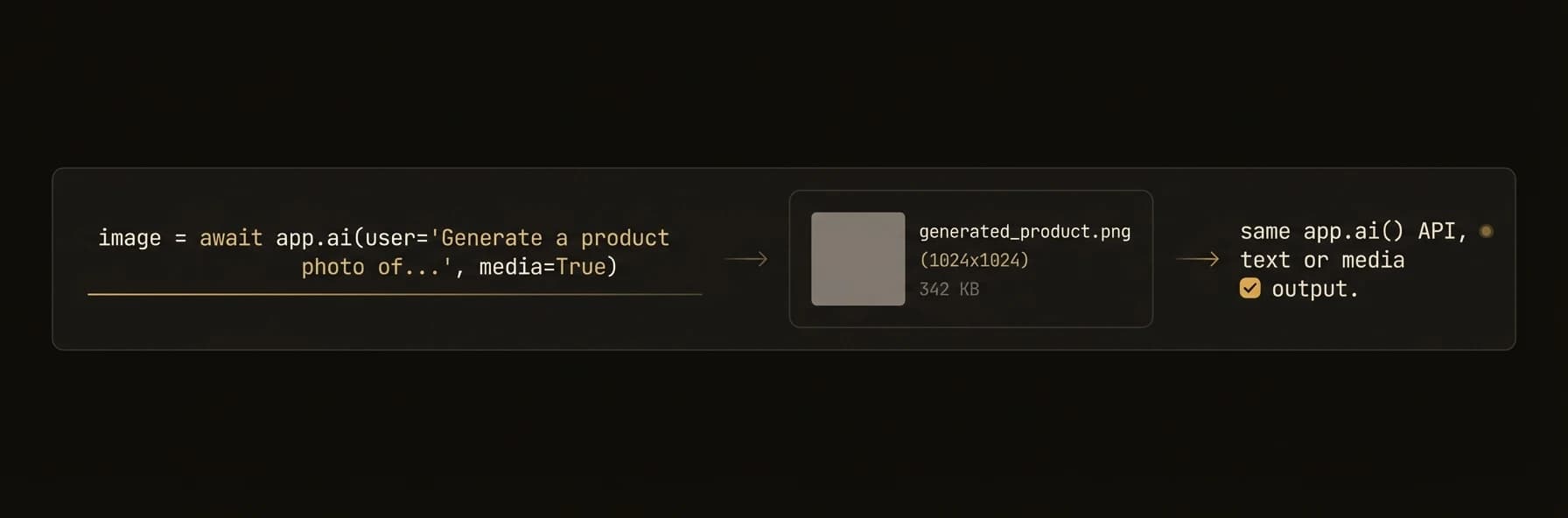
Generate images, audio, video, and music from your agents — same method pattern across Python, TypeScript, and Go.
Agents that generate reports, product listings, marketing content, or customer-facing assets often need more than text. AgentField's media generation API lets you create images, narrate text, produce video, generate music, and transcribe audio through a unified interface backed by pluggable providers like fal.ai, OpenRouter, DALL-E, and ElevenLabs.
from agentfield import Agent, AIConfig

app = Agent(
    node_id="product-listing-generator",
    ai_config=AIConfig(
        fal_api_key="your-fal-key",           # or FAL_KEY env var
        openrouter_api_key="your-or-key",      # or OPENROUTER_API_KEY env var
    ),
)

@app.reasoner()
async def generate_product_listing(product: dict) -> dict:
    # Generate a product image via OpenRouter (Gemini)
    image = await app.ai_generate_image(
        prompt=f"Professional product photo: {product['name']}",
        model="openrouter/google/gemini-3.1-flash-image-preview",
    )
    image.images[0].save(f"/output/{product['id']}_hero.png")

    # Generate a short product demo video via OpenRouter
    video = await app.ai_generate_video(
        prompt=f"Product demonstration: {product['name']} in use",
        model="openrouter/kling-video/v2.0/master",
        duration=10,
    )
    if video.videos:
        video.videos[0].save(f"/output/{product['id']}_demo.mp4")

    # Generate audio narration
    audio = await app.ai_generate_audio(
        text=f"Introducing {product['name']}: {product['description']}",
        model="openrouter/openai/tts-1",
        voice="alloy",
    )
    if audio.audio:
        audio.audio.save(f"/output/{product['id']}_narration.wav")

    # Generate background music
    music = await app.ai_generate_music(
        prompt="Upbeat corporate background music for product video",
        model="openrouter/google/lyria-3-pro",
        duration=30,
    )
    if music.audio:
        music.audio.save(f"/output/{product['id']}_bgm.wav")

    return {
        "image_url": image.images[0].url if image.images else None,
        "video_url": video.videos[0].url if video.videos else None,
        "audio_url": audio.audio.url if audio.audio else None,
    }
import { Agent } from "@agentfield/sdk";
import { OpenRouterMediaProvider, MediaRouter } from "@agentfield/sdk";
const agent = new Agent({ nodeId: "media-agent" });
// Set up media provider
const media = new OpenRouterMediaProvider(); // reads OPENROUTER_API_KEY env var
agent.reasoner("generateAssets", async (ctx) => {
// Generate product image
const image = await media.generateImage({
prompt: `Professional product photo: ${ctx.input.name}`,
model: "google/gemini-3.1-flash-image-preview",
});
console.log(`Generated ${image.images.length} image(s)`);
// Generate product demo video (async polling)
const video = await media.generateVideo({
prompt: `Product demo: ${ctx.input.name} in use`,
model: "kling-video/v2.0/master",
duration: 10,
timeout: 600_000,
});
console.log(`Video: ${video.videos?.[0]?.url}`);
// Generate audio narration (SSE streaming)
const audio = await media.generateAudio({
text: `Introducing ${ctx.input.name}`,
model: "openai/tts-1",
voice: "alloy",
});
return {
imageUrl: image.images[0]?.url,
videoUrl: video.videos?.[0]?.url,
hasAudio: !!audio.audio,
};
});
agent.serve();package main
import (
"context"
"fmt"
"log"
"os"
"github.com/Agent-Field/agentfield/sdk/go/agent"
goai "github.com/Agent-Field/agentfield/sdk/go/ai"
)
func main() {
app, _ := agent.New(agent.Config{
NodeID: "media-agent",
Version: "1.0.0",
})
// Set up media provider
media, err := goai.NewOpenRouterMediaProvider(os.Getenv("OPENROUTER_API_KEY"))
if err != nil {
log.Fatal(err)
}
app.RegisterReasoner("generateAssets", func(ctx context.Context, input map[string]any) (any, error) {
name, _ := input["name"].(string)
// Generate product image
image, err := media.GenerateImage(ctx, goai.ImageRequest{
Prompt: fmt.Sprintf("Professional product photo: %s", name),
Model: "google/gemini-3.1-flash-image-preview",
})
if err != nil {
return nil, err
}
// Generate demo video (async polling)
video, err := media.GenerateVideo(ctx, goai.VideoRequest{
Prompt: fmt.Sprintf("Product demo: %s in use", name),
Model: "kling-video/v2.0/master",
Duration: 10,
})
if err != nil {
return nil, err
}
// Generate audio narration (SSE streaming)
audio, err := media.GenerateAudio(ctx, goai.AudioRequest{
Text: fmt.Sprintf("Introducing %s", name),
Model: "openai/tts-1",
Voice: "alloy",
})
if err != nil {
return nil, err
}
return map[string]any{
"images": len(image.Images),
"video": len(video.Videos) > 0,
"audio": audio.Audio != nil,
}, nil
})
app.Serve(context.Background())
}What you get back
Every SDK returns typed response objects with saveable files and URLs — not raw provider responses you have to normalize yourself.
{
  "image_url": "https://cdn.example.com/product_hero.webp",
  "video_url": "https://cdn.example.com/product_demo.mp4",
  "audio_url": "https://cdn.example.com/product_narration.wav",
  "music_url": "https://cdn.example.com/background_music.wav"
}