AI Generation
Text generation and structured output with app.ai() — the universal method for LLM calls
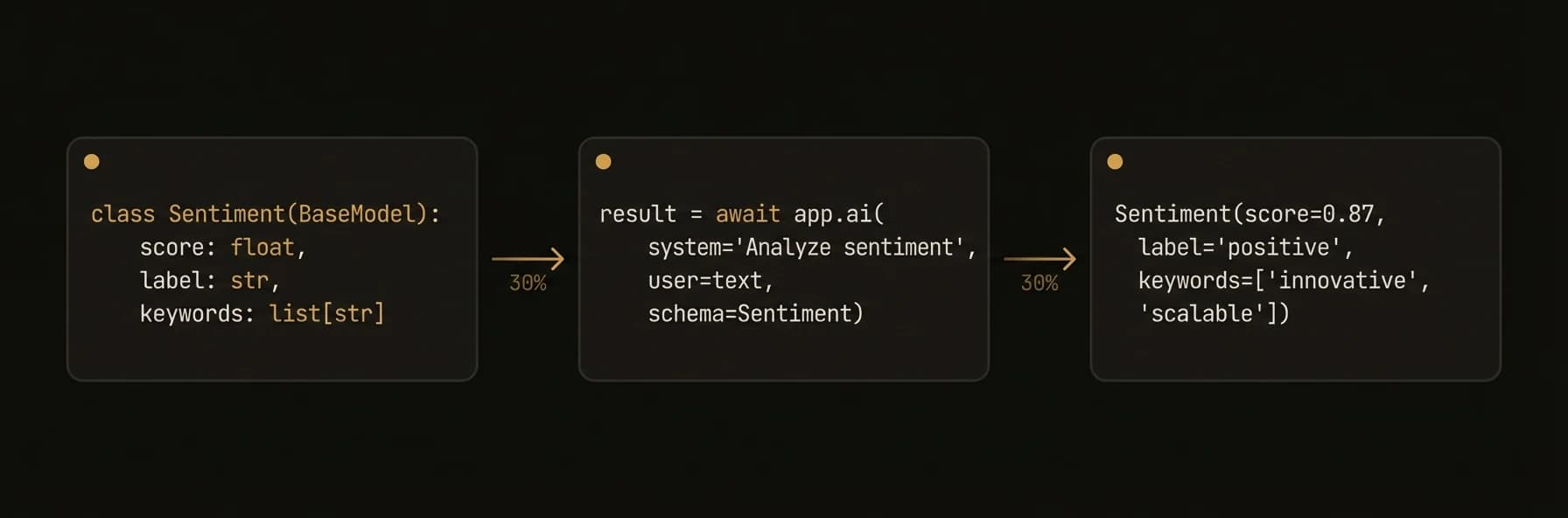
Call any LLM with a single method. Pass a prompt, get text back. Pass a schema, get a validated object back. Override the model, temperature, or any other parameter per-call without changing your agent config. Works with 100+ models via LiteLLM (Python), Vercel AI SDK (TypeScript), or OpenAI-compatible APIs (Go).
from pydantic import BaseModel

class LeadScore(BaseModel):
    score: float          # 0-100 likelihood to convert
    reasoning: str        # why this score
    next_action: str      # recommended sales action
    urgency: str          # "high" | "medium" | "low"

# Structured output — pass a schema, get a validated typed object back
lead = await app.ai(
    system="You are a B2B sales analyst scoring inbound leads.",
    user="Company: Acme Corp, 500 employees, viewed pricing page 3x this week",
    schema=LeadScore,
)
print(lead.score)        # 82.5  — not a string, a float
print(lead.next_action)  # "Schedule demo within 24 hours"

# Override model per-call — cheap model for fast classification
category = await app.ai(
    user=ticket_text,
    schema=TicketCategory,
    model="openai/gpt-4o-mini",        # 10x cheaper, good enough for routing
)

# Powerful model for deep analysis — same method, different model
analysis = await app.ai(
    system="Provide root cause analysis with remediation steps.",
    user=ticket_text,
    schema=RootCauseAnalysis,
    model="anthropic/claude-sonnet-4-20250514",  # best reasoning for hard problems
)

# Streaming — real-time token delivery for interactive UIs
response = await app.ai(
    system="Write a detailed post-mortem.",
    user=incident_summary,
    stream=True,
)
async for chunk in response:
    print(chunk.choices[0].delta.content, end="")

# Automatic fallback chain — if primary model fails, try the next
app = Agent(
    node_id="resilient-agent",
    ai_config=AIConfig(
        model="anthropic/claude-sonnet-4-20250514",
        fallback_models=["openai/gpt-4o", "deepseek/deepseek-chat"],
        max_cost_per_call=0.05,         # hard cost cap per call
    ),
)
import { z } from 'zod';
const LeadScore = z.object({
score: z.number(), // 0-100 likelihood to convert
reasoning: z.string(), // why this score
nextAction: z.string(), // recommended sales action
urgency: z.enum(['high', 'medium', 'low']),
});
agent.reasoner('scoreInboundLead', async (ctx) => {
// Structured output — Zod schema in, validated typed object out
const lead = await ctx.ai(ctx.input.leadDescription, {
system: 'You are a B2B sales analyst scoring inbound leads.',
schema: LeadScore,
});
console.log(lead.score); // 82.5 — typed number, not string
// Override model per-call — cheap for routing, powerful for analysis
const category = await ctx.ai(ticketText, {
schema: TicketCategory,
model: 'gpt-4o-mini', // fast + cheap for classification
});
const analysis = await ctx.ai(ticketText, {
system: 'Provide root cause analysis with remediation steps.',
schema: RootCauseAnalysis,
model: 'claude-sonnet-4-20250514', // deep reasoning
});
// Streaming — real-time token delivery
const stream = await ctx.aiStream('Write a post-mortem.', {
system: 'You are an SRE writing an incident report.',
});
for await (const chunk of stream) {
process.stdout.write(chunk);
}
return lead;
});type LeadScore struct {
Score float64 `json:"score"` // 0-100 likelihood to convert
Reasoning string `json:"reasoning"` // why this score
NextAction string `json:"next_action"` // recommended sales action
Urgency string `json:"urgency"` // high | medium | low
}
// Structured output — Go struct in, validated JSON out
resp, _ := client.Complete(ctx,
"Company: Acme Corp, 500 employees, viewed pricing page 3x",
ai.WithSystem("You are a B2B sales analyst scoring inbound leads."),
ai.WithSchema(LeadScore{}),
)
var lead LeadScore
resp.JSON(&lead)
fmt.Printf("Score: %.1f, Action: %s\n", lead.Score, lead.NextAction)
// Override model per-call — cheap for classification
catResp, _ := client.Complete(ctx, ticketText,
ai.WithModel("gpt-4o-mini"), // fast routing
ai.WithSchema(TicketCategory{}),
)
// Powerful model for hard problems
analysisResp, _ := client.Complete(ctx, ticketText,
ai.WithModel("anthropic/claude-sonnet-4-20250514"),
ai.WithSystem("Provide root cause analysis."),
ai.WithSchema(RootCauseAnalysis{}),
ai.WithTemperature(0.0), // deterministic for analysis
)What just happened
The same ai() call handled three common production modes without changing your surrounding code: typed extraction with a schema, a cheap model override for simple classification, and a stronger model override for deeper analysis. The page’s main point is that you do not need separate client stacks for each of those paths.
{
  "lead_score": {
    "score": 8.7,
    "next_action": "schedule_demo"
  },
  "ticket_category": {
    "category": "billing"
  },
  "analysis": {
    "root_cause": "misconfigured webhook retry policy"
  }
}Harness
Run a coding agent from inside agent loops with turn caps, schema-bound output, and retries. AForge is the default — Claude Code, Codex, Gemini, and OpenCode are one field away.
Harness
Harness orchestration. AForge runs by default with nothing to install; Claude Code, Codex, Gemini CLI, and OpenCode are one field away.