BuildIntelligence
Models
100+ LLMs via LiteLLM — model-agnostic configuration, cost controls, and rate limiting
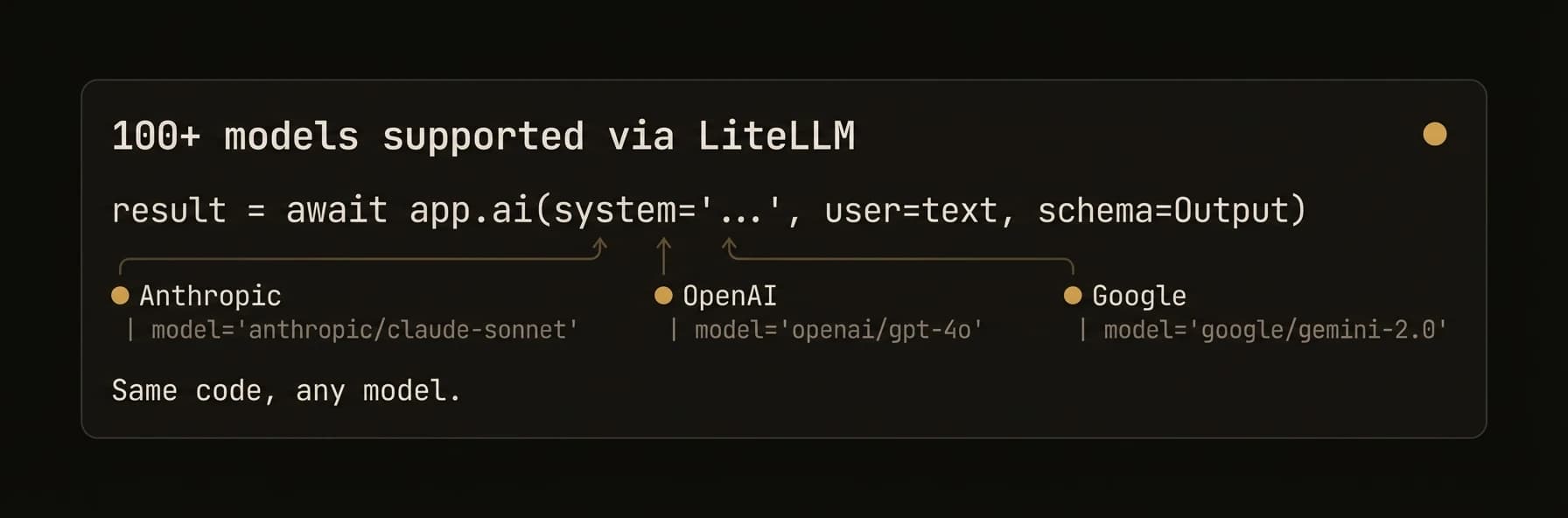
Use any LLM. Switch models per-call. Set cost caps. Auto-retry on rate limits. AgentField is model-agnostic -- the Python SDK routes through LiteLLM for 100+ models from every major provider, TypeScript uses the Vercel AI SDK, and Go uses OpenAI-compatible HTTP APIs directly.
from agentfield import Agent, AIConfig, HarnessConfig

# Agent-level config — defaults for all .ai() calls
app = Agent(
    node_id="production-agent",
    ai_config=AIConfig(
        model="anthropic/claude-sonnet-4-20250514",       # default model
        fallback_models=[                                  # auto-failover chain
            "openai/gpt-4o",
            "deepseek/deepseek-chat",
        ],
        max_cost_per_call=0.05,                            # hard cap per call
        daily_budget=10.00,                                # daily spend limit
        enable_rate_limit_retry=True,                      # auto-retry with backoff
        rate_limit_max_retries=10,
        auto_inject_memory=["user_prefs", "conversation"], # inject memory into prompts
    ),
    # Harness uses a DIFFERENT config — coding agents have their own limits.
    # No provider/model: runs AForge, the default harness, on its own model.
    harness_config=HarnessConfig(
        max_turns=30,              # AForge bounds a run by iterations, not dollars
    ),
)

# Per-call model override — no agent reconfiguration needed
category = await app.ai(
    user=ticket_text,
    schema=TicketCategory,
    model="openai/gpt-4o-mini",   # cheap model for fast classification
)

analysis = await app.ai(
    user=ticket_text,
    schema=DeepAnalysis,
    model="anthropic/claude-sonnet-4-20250514",  # powerful model for reasoning
    temperature=0.0,                              # deterministic
)

# Local models — zero data leaves your machine
local_app = Agent(
    node_id="local-agent",
    ai_config=AIConfig(
        model="ollama/llama3",
        api_base="http://localhost:11434",
    ),
)
import { Agent } from '@agentfield/sdk';
const agent = new Agent({
nodeId: 'production-agent',
aiConfig: {
provider: 'anthropic',
model: 'claude-sonnet-4-20250514', // default model
temperature: 0.3,
maxTokens: 4096,
enableRateLimitRetry: true, // auto-retry with backoff
rateLimitMaxRetries: 20,
},
});
agent.reasoner('analyze', async (ctx) => {
// Per-call model override — cheap for routing, powerful for analysis
const category = await ctx.ai(ticketText, {
model: 'gpt-4o-mini', // fast + cheap
schema: TicketCategory,
});
const analysis = await ctx.ai(ticketText, {
model: 'claude-sonnet-4-20250514', // deep reasoning
schema: DeepAnalysis,
temperature: 0.0,
});
// Harness — its own caps, separate from .ai(). No provider: runs AForge, the default.
// Add `provider: 'codex'` (or claude-code / gemini / opencode) to pick a different worker.
const fix = await agent.harness('Fix the failing test in auth.test.ts', {
maxTurns: 20,
});
return { category, analysis };
});// Agent-level config
config := &ai.Config{
APIKey: os.Getenv("OPENROUTER_API_KEY"),
BaseURL: "https://openrouter.ai/api/v1",
Model: "anthropic/claude-sonnet-4-20250514", // default model
}
client, _ := ai.NewClient(config)
// Per-call model override
catResp, _ := client.Complete(ctx, ticketText,
ai.WithModel("gpt-4o-mini"), // cheap for classification
ai.WithSchema(TicketCategory{}),
)
analysisResp, _ := client.Complete(ctx, ticketText,
ai.WithModel("anthropic/claude-sonnet-4-20250514"), // powerful for analysis
ai.WithTemperature(0.0),
ai.WithSchema(DeepAnalysis{}),
)| Provider | Python (LiteLLM) | TypeScript (Vercel AI) | Go (HTTP) |
|---|---|---|---|
| OpenAI | openai/gpt-4o | openai provider | Default |
| Anthropic | anthropic/claude-sonnet-4-20250514 | anthropic provider | Via OpenRouter |
| Google Gemini | gemini/gemini-2.5-pro | google provider | Via OpenRouter |
| Mistral | mistral/mistral-large-latest | mistral provider | Via OpenRouter |
| DeepSeek | deepseek/deepseek-chat | deepseek provider | Via OpenRouter |
| Groq | groq/llama-3.1-70b | groq provider | Via OpenRouter |
| xAI | xai/grok-2 | xai provider | Via OpenRouter |
| Cohere | cohere/command-r-plus | cohere provider | Via OpenRouter |
| OpenRouter | openrouter/... | openrouter provider | Native |
| Ollama | ollama/llama3 | ollama provider | Native |
| Azure OpenAI | azure/gpt-4o | Via OpenAI adapter | Via URL |
| AWS Bedrock | bedrock/... | N/A | N/A |
What just happened
The example set a default model once and then overrode it only where the task changed. That is the practical pattern this page should teach: keep one baseline model for most calls, then switch to a cheaper or stronger model per execution instead of rebuilding your agent around provider-specific clients.
{
  "default_model": "gpt-4o",
  "classification_override": "gpt-4o-mini",
  "analysis_override": "anthropic/claude-sonnet-4-20250514"
}