Databricks
Verify Databricks notification destination webhooks and expose Databricks SQL, AI Functions, and Model Serving as AgentField capabilities.
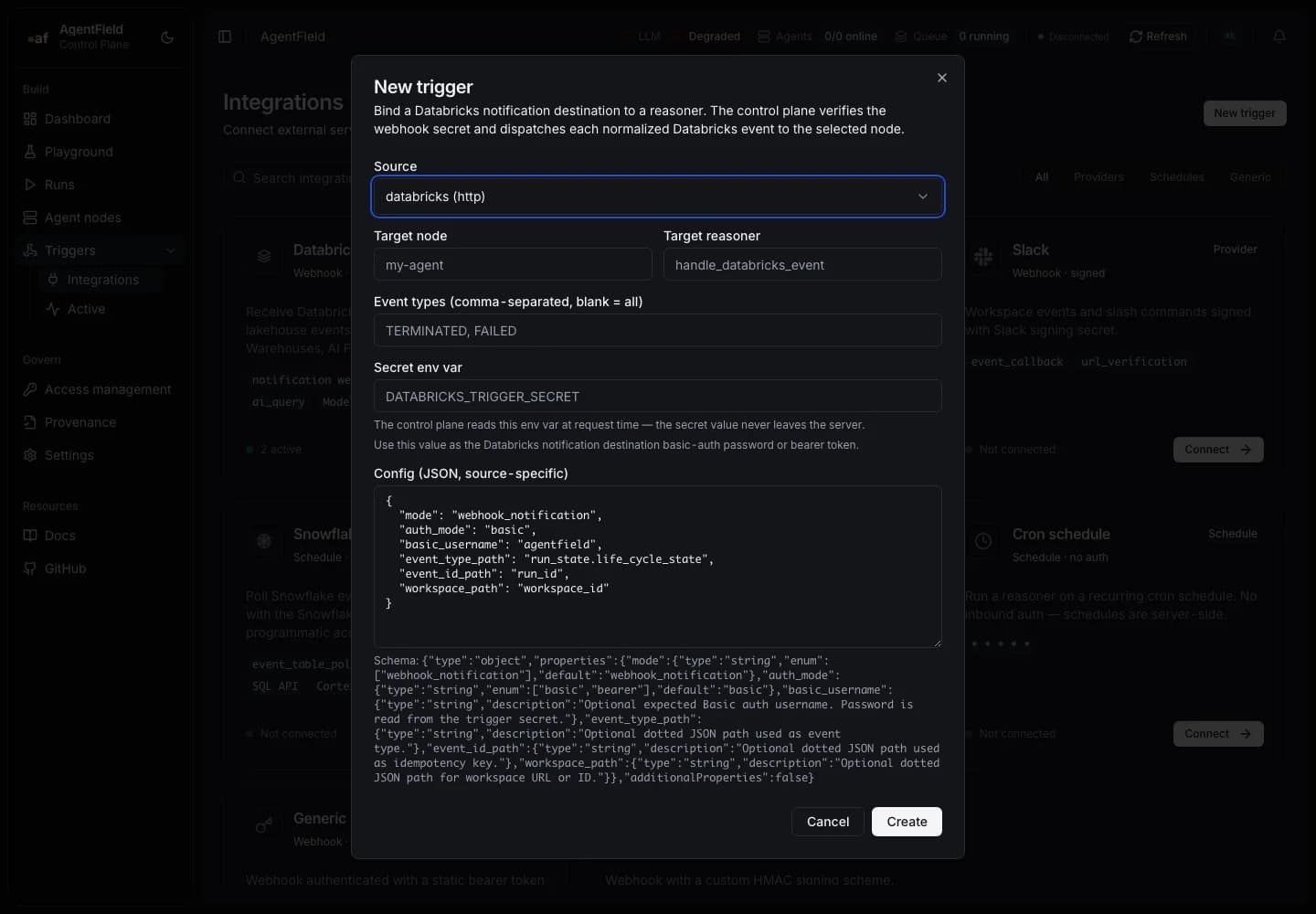
Databricks has two OSS surfaces:
- A built-in control-plane source named
databricksfor Databricks notification destination webhooks. - An optional deployable Databricks node that exposes lakehouse data and AI capabilities through
app.call.
Trigger Source
Databricks workspace notification destinations (Jobs, SQL alerts, Lakehouse Monitoring) POST signed webhooks to AgentField. The control plane verifies the request, deduplicates by event id, and dispatches through the normal execution path.
Create a trigger with:
- source:
databricks - target reasoner:
databricks-prod.handle_databricks_eventor your own webhook-enabled reasoner - secret env var:
DATABRICKS_TRIGGER_SECRET
{
  "auth_mode": "basic",
  "basic_username": "agentfield",
  "event_type_path": "run_state.life_cycle_state",
  "event_id_path": "run_id",
  "workspace_path": "workspace_id"
}
auth_mode supports basic and bearer. The AgentField trigger secret value becomes the Databricks webhook destination password (basic) or bearer token. Trigger config stores only the env-var name.
The *_path fields are JSON paths into the inbound payload that the source uses to derive a normalized event type, idempotency key, and workspace id. Defaults match the Databricks Jobs run-state payload shape.
Event Payload
Reasoners receive the normalized payload under event and dispatch metadata under _meta:
{
  "event": {
    "event_id": "1024-103045-abcdef",
    "event_type": "databricks.run_state.INTERNAL_ERROR",
    "workspace_id": "1234567890123456",
    "received_at": "2026-06-15T10:30:00Z",
    "payload": {
      "run_id": "1024-103045-abcdef",
      "job_id": 42,
      "run_state": { "life_cycle_state": "INTERNAL_ERROR", "result_state": "FAILED" }
    },
    "databricks": {
      "source": "notification_destination",
      "request_path": "/triggers/databricks-prod-failures"
    }
  },
  "_meta": {
    "source": "databricks",
    "event_type": "databricks.run_state.INTERNAL_ERROR",
    "idempotency_key": "1024-103045-abcdef"
  }
}
Capability Node
Deploy the optional node when agents need to query Databricks SQL, run AI Functions, or invoke a Model Serving endpoint from other AgentField nodes.
The OSS package is in integrations/databricks. The node image is built from integrations/databricks/node/Dockerfile, which expects the repository root as the Docker build context; the package also includes a docker-compose.example.yml.
git clone https://github.com/Agent-Field/agentfield.git
cd agentfield
docker build \
  -f integrations/databricks/node/Dockerfile \
  -t agentfield-databricks-node:latest \
  .
docker run --name agentfield-databricks \
-p 18112:18112 \
-e AGENTFIELD_URL=http://host.docker.internal:18080 \
-e AGENT_NODE_ID=databricks-prod \
-e AGENT_CALLBACK_URL=http://localhost:18112 \
-e DATABRICKS_HOST=https://dbc-xxx.cloud.databricks.com \
-e DATABRICKS_TOKEN=<personal-access-token> \
-e DATABRICKS_WAREHOUSE_ID=<sql-warehouse-id> \
-e DATABRICKS_CATALOG=workspace \
-e DATABRICKS_SCHEMA=agentfield \
agentfield-databricks-node:latestCall it from any SDK:
result = await app.call("databricks-prod.query_readonly", input={
    "sql": "SELECT event_type, COUNT(*) FROM main.ops.events GROUP BY event_type",
})
const result = await ctx.call('databricks-prod.query_readonly', {
sql: 'SELECT event_type, COUNT(*) FROM main.ops.events GROUP BY event_type',
});result, err := a.Call(ctx, "databricks-prod.query_readonly", map[string]any{
"sql": "SELECT event_type, COUNT(*) FROM main.ops.events GROUP BY event_type",
})The node registers these callable reasoners. Descriptions come from the OSS package contracts and node registration code.
| Capability | Description | Input | Output |
|---|---|---|---|
health | Report Databricks node configuration health. | {} | status, node_id, defaults (host, warehouse, catalog, schema, AI endpoint), prompt source/version. |
query_readonly | Run a guarded read-only Databricks SQL statement through the Statement Execution API. | sql; optional warehouse_id, catalog, schema, parameters, max_rows, timeout_seconds. | statement_id, columns, rows, row_count, truncated, provenance. |
describe_table | Describe a Unity Catalog table or view. | object. | statement_id, columns, rows, provenance. |
search_columns | Search Unity Catalog information_schema.columns for matching columns. | query; optional catalog, schema, limit. | matches, provenance. |
ai_query | Call Databricks AI Functions through SQL (ai_query). | prompt; optional endpoint, return_type, fail_on_error. | statement_id, rows, provenance. |
invoke_serving_endpoint | Invoke a Databricks Model Serving endpoint. | endpoint, body. | raw response. |
explain_result | Explain a Databricks result preview using a configured prompt routed through ai_query. | result or result_preview; optional question, endpoint. | answer, statement_id, prompt source. |
investigate_metric_change | Plan a bounded metric-change investigation. | metric_name, time_window. | status, rendered prompt, recommended follow-up calls, prompt source. |
handle_databricks_event | Webhook entrypoint for Databricks notification destination events. | Normalized trigger event. | Acknowledgement plus summarized event metadata. |
Typical DX is to let a Databricks trigger wake a domain reasoner, then call the Databricks node only for data and AI work:
@app.reasoner()
async def review_databricks_event(input: dict):
    event = input["event"]
    metrics = await app.call("databricks-prod.query_readonly", input={
        "sql": f"SELECT * FROM ops.events WHERE event_id = '{event['event_id']}'",
    })
    review = await app.call("databricks-prod.ai_query", input={
        "endpoint": "databricks-meta-llama-3-1-8b-instruct",
        "prompt": "Summarize the operational risk in this result set as compact JSON.",
        "fail_on_error": True,
    })
return {"event_id": event["event_id"], "metrics": metrics, "review": review}agent.reasoner('reviewDatabricksEvent', async (ctx) => {
const { event } = ctx.input;
const metrics = await ctx.call('databricks-prod.query_readonly', {
sql: `SELECT * FROM ops.events WHERE event_id = '${event.event_id}'`,
});
const review = await ctx.call('databricks-prod.ai_query', {
endpoint: 'databricks-meta-llama-3-1-8b-instruct',
prompt: 'Summarize the operational risk in this result set as compact JSON.',
fail_on_error: true,
});
return { event_id: event.event_id, metrics, review };
});a.RegisterReasoner("review_databricks_event", func(ctx context.Context, input map[string]any) (any, error) {
event, _ := input["event"].(map[string]any)
eventID, _ := event["event_id"].(string)
metrics, err := a.Call(ctx, "databricks-prod.query_readonly", map[string]any{
"sql": fmt.Sprintf("SELECT * FROM ops.events WHERE event_id = '%s'", eventID),
})
if err != nil {
return nil, err
}
review, err := a.Call(ctx, "databricks-prod.ai_query", map[string]any{
"endpoint": "databricks-meta-llama-3-1-8b-instruct",
"prompt": "Summarize the operational risk in this result set as compact JSON.",
"fail_on_error": true,
})
if err != nil {
return nil, err
}
return map[string]any{"event_id": eventID, "metrics": metrics, "review": review}, nil
})A runnable version of this pattern lives in integrations/databricks/examples/incident-reviewer.
Guardrails
- Default SQL capability is read-only.
SELECT,WITH,SHOW,DESCRIBE, andEXPLAINare allowed; DDL, DML,COPY INTO,CALL, and role switching are denied. - The Databricks SQL warehouse is the enforcement boundary — even allowed statements that mutate data are refused by Databricks when the warehouse is configured for read-only access.
ai_queryandinvoke_serving_endpointkeep inference inside Databricks. They do not wrap AgentField.aicalls.- Prompt-backed reasoners load prompts from
DATABRICKS_PROMPTS_FILEor packaged defaults, not hardcoded customer behavior.