Integrations
First-party AgentField open-source integration sources, capability packs, and coding-agent harness providers.
AgentField integrations are source plugins and capability nodes that ship in the open-source repo. They are not a generic catalog of every SaaS tool the website mentions.
For partner or cross-org agent capabilities that are not first-party integration packs, use external agent discovery. Internal AgentField agents should still communicate through app.call("node.function"); Agentic Resource Discovery is for the outside-network case where a capability must be discoverable, imported, and approved before it becomes callable through an external.* target.
What Ships Today
Data
Snowflake
Poll warehouse event tables and optionally deploy a Snowflake capability node.
Databricks
Verify Databricks notification destination webhooks and optionally deploy a Databricks capability node.
Coding agents — autonomous-loop providers
Each provider plugs into app.harness(...) so any agent can spawn a coding agent inside a programmatic loop. AForge is the default — it ships with af, so a harness call with no provider works with nothing extra installed. The rest are optional overrides: set provider="claude-code", "codex", "gemini", or "opencode" and the rest of your loop is unchanged.
AForge — the default harness
Ships with af. No CLI install, no vendor account — just OPENROUTER_API_KEY.
Anthropic — Claude Code
The careful reasoner. Plan mode, surgical edits, multi-turn refactors.
OpenAI — Codex
The fast implementer. Greenfield code across OpenAI's coding-agent CLI.
Google — Gemini CLI
The long-context worker. Whole-repo passes with massive context windows.
OpenCode
The open-model path. Llama, Qwen, DeepSeek, or anything you self-host.
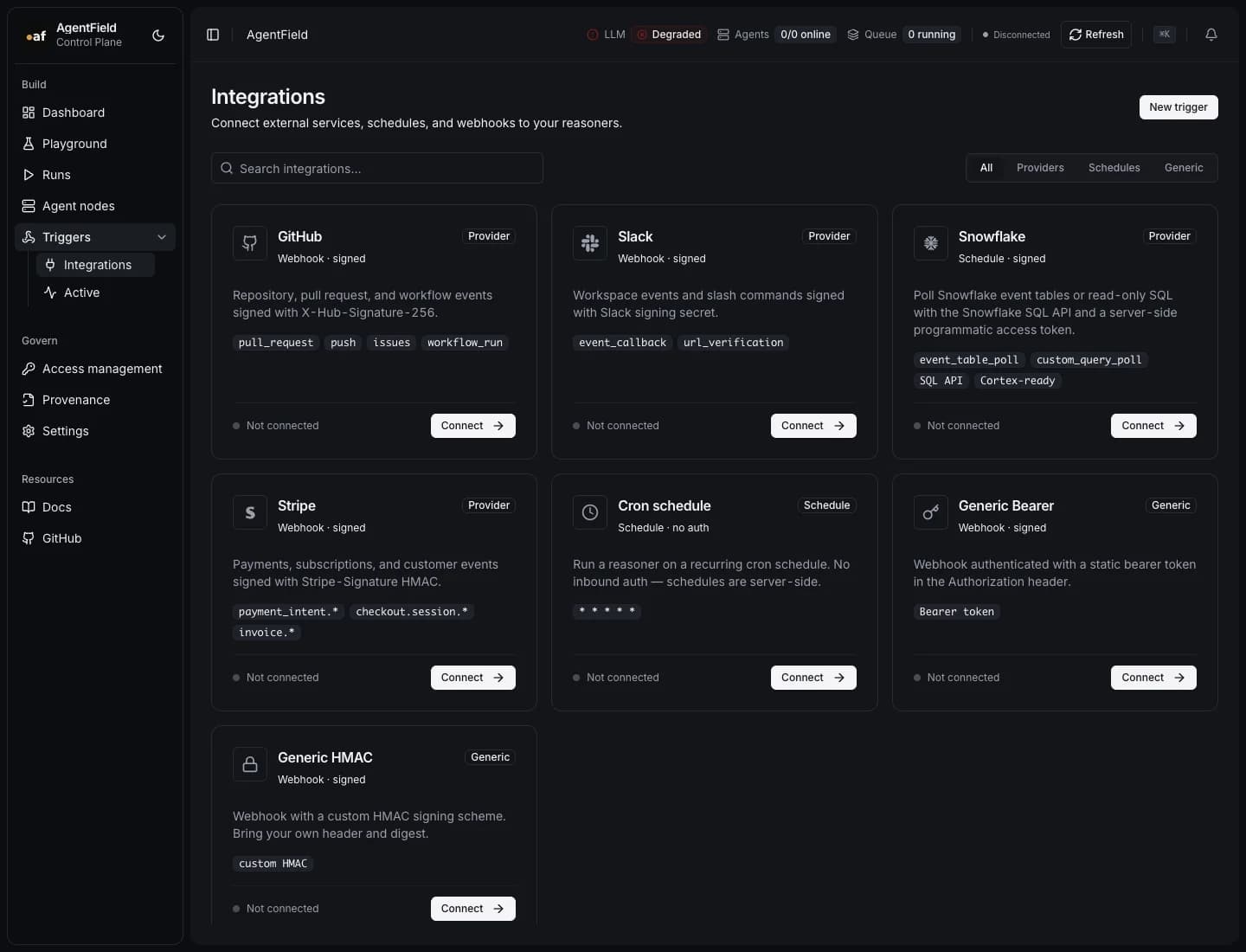
Triggers
GitHub
Verify GitHub webhooks and dispatch pull request, issue, push, and workflow events.
Slack
Verify Slack Events API requests and route workspace events to reasoners.
Stripe
Verify Stripe webhooks and dispatch payment, checkout, invoice, and customer events.
Cron
Run a reasoner on a server-side schedule.
Custom webhooks
Use generic HMAC or Bearer sources for systems that can POST JSON.
Surfaces
Trigger sources wake a reasoner from an external event. The control plane verifies the request or runs the polling loop, records inbound event history, deduplicates by idempotency key, and dispatches through the normal execution path.
Capability nodes expose callable tools to every SDK through app.call. Snowflake and Databricks are the first integration packs with this shape — their nodes publish SQL, catalog, and AI capabilities (Cortex for Snowflake, AI Functions and Model Serving for Databricks) with explicit inputs and outputs.
External agent discovery is the interoperability surface for capabilities that live outside this repo or outside your organization. It is not a substitute for first-party integrations or internal AgentField discovery; it is the opt-in path for public discovery, import, and carefully scoped callability.
Coding-agent harnesses drive a coding agent from inside your loop. By default that agent is AForge, AgentField's native harness, which is provisioned with af; naming a provider swaps in Claude Code, Codex, Gemini CLI, or OpenCode instead. app.harness(...) returns structured results with budget caps, retries, and schema-bound output, so you can wrap a coding agent in retry-with-fallback or tournament patterns without rewiring per provider.
Custom webhooks cover tools that are not first-party integrations. For example, Zapier can POST into generic_hmac or generic_bearer, but AgentField does not ship a native Zapier adapter.
Every integration page documents the shipped source name, auth model, event type, idempotency key, normalized reasoner input, and any callable capabilities. If a page does not list a capability node, the OSS repo only ships the trigger source for that integration.
Common Setup Shape
from agentfield import Agent, on_event

app = Agent(node_id="ops-agent")

@app.reasoner()
@on_event(source="github", types=["pull_request.opened"], secret_env="GITHUB_WEBHOOK_SECRET")
async def review_pr(event: dict, trigger=None):
    return {"delivery": trigger.idempotency_key if trigger else None}

app.run()
package main
import (
"context"
"log"
"github.com/Agent-Field/agentfield/sdk/go/agent"
)
func main() {
a, err := agent.New(agent.Config{NodeID: "ops-agent"})
if err != nil {
log.Fatal(err)
}
a.RegisterReasoner("review_pr", func(ctx context.Context, input map[string]any) (any, error) {
meta, _ := input["_meta"].(map[string]any)
return map[string]any{"delivery": meta["idempotency_key"]}, nil
},
agent.WithEventTrigger("github", "pull_request.opened"),
agent.WithTriggerSecretEnv("GITHUB_WEBHOOK_SECRET"),
)
if err := a.Serve(context.Background()); err != nil {
log.Fatal(err)
}
}For UI setup, open Triggers -> Integrations, choose the source, and connect it to a registered node and reasoner.