Testing
Patterns for unit testing, integration testing, and mocking AgentField agents.
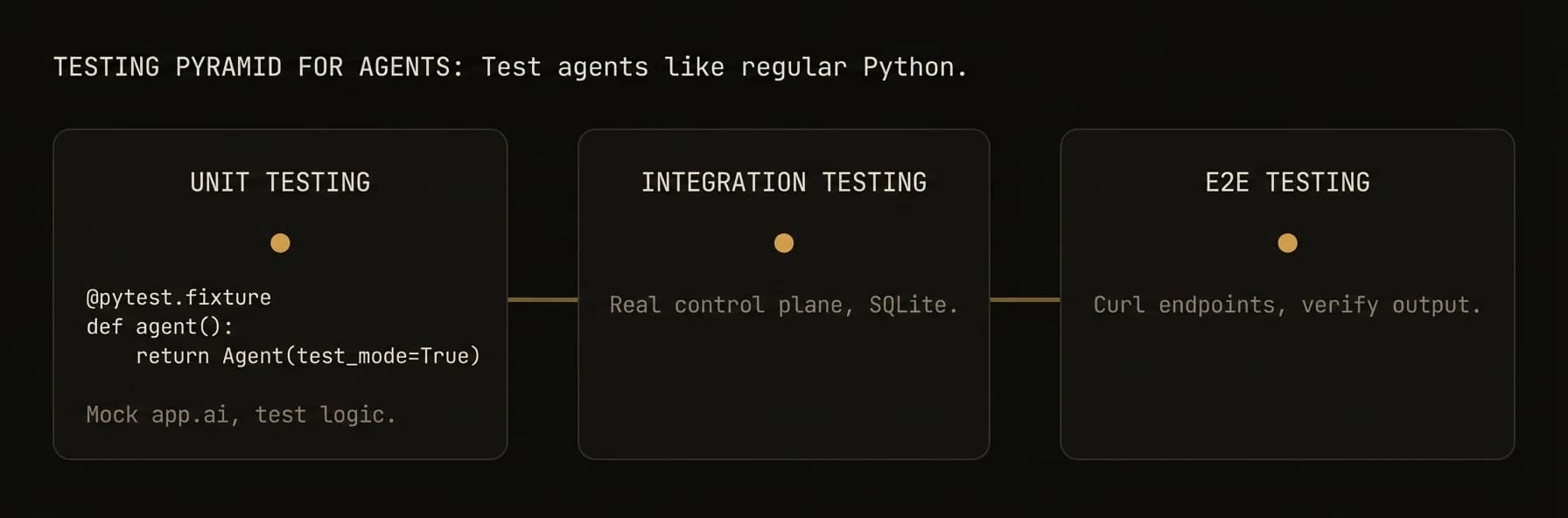
Write deterministic, fast tests for your agents — from unit tests to full integration suites.
AgentField agents are regular Python functions decorated with @app.reasoner() and @app.skill(). This means you can test them with standard tools like pytest, mock LLM calls for deterministic assertions, and run integration tests against a local backend.
Unit Testing Reasoners
Reasoner functions receive an app context and input. To test them in isolation, create a test agent with mocked dependencies.
# src/agents/classifier.py
from agentfield import Agent, AIConfig
from pydantic import BaseModel

app = Agent(
    node_id="classifier",
    ai_config=AIConfig(model="anthropic/claude-sonnet-4-20250514"),
)

class Classification(BaseModel):
    category: str
    confidence: float

@app.reasoner()
async def classify(text: str) -> Classification:
    result = await app.ai(
        system="Classify the following text into a category.",
        user=text,
        schema=Classification,
    )
    return result
# tests/test_classifier.py
import pytest
from unittest.mock import AsyncMock, patch
from src.agents.classifier import app, classify, Classification
@pytest.mark.asyncio
async def test_classify_returns_valid_category():
app.ai = AsyncMock(return_value=Classification(
category="technical",
confidence=0.95,
))
result = await classify(text="How to configure Kubernetes pods")
assert result.category == "technical"
assert result.confidence >= 0.9
app.ai.assert_called_once()The key pattern: replace app.ai (and app.call) with AsyncMock instances so no real LLM calls happen. Your test runs in milliseconds and produces deterministic results.
What just happened
The test exercised the reasoner directly while replacing the model call with a mock. That keeps the feedback loop fast and makes the assertion about your logic, not about whether an external provider responded the same way twice.
{
  "execution_mode": "local_test",
  "llm_dependency": "mocked",
  "focus": "reasoner_logic"
}
Mocking AI Calls
app.ai() is the most common call to mock. Control exactly what the LLM "returns" so you can test downstream logic.
# tests/test_intake.py
import pytest
from unittest.mock import AsyncMock
from pydantic import BaseModel

class IntakeResult(BaseModel):
    contract_type: str
    parties: list[str]
    confident: bool

@pytest.mark.asyncio
async def test_intake_confident_path():
    """When .ai() is confident, skip the fallback."""
    from src.agents.intake import app, process_intake

    app.ai = AsyncMock(return_value=IntakeResult(
        contract_type="NDA",
        parties=["Acme Corp", "Globex Inc"],
        confident=True,
    ))
    app.call = AsyncMock()

    result = await process_intake(document="...")

    assert result.contract_type == "NDA"
    # Verify the fallback was NOT called
    app.call.assert_not_called()

@pytest.mark.asyncio
async def test_intake_fallback_when_not_confident():
    """When .ai() returns confident=False, escalate via cross-agent call."""
    from src.agents.intake import app, process_intake

    app.ai = AsyncMock(return_value=IntakeResult(
        contract_type="unknown",
        parties=[],
        confident=False,
    ))
    app.call = AsyncMock(return_value={
        "contract_type": "MSA",
        "parties": ["Acme Corp", "Globex Inc"],
        "confident": True,
    })

    result = await process_intake(document="...")

    assert result.contract_type == "MSA"
    app.call.assert_called_once()
Testing Multiple AI Calls in Sequence
When a reasoner makes several app.ai() calls, use side_effect to return different values for each call:
@pytest.mark.asyncio
async def test_multi_step_reasoning():
    from src.agents.analyzer import app, analyze_document

    app.ai = AsyncMock(side_effect=[
        Classification(category="legal", confidence=0.8),
        RiskScore(score=7, explanation="High liability exposure"),
    ])

    result = await analyze_document(text="...")

    assert app.ai.call_count == 2
    assert result.risk_score == 7
Mocking Cross-Agent Calls
app.call() invokes other agents over the network. Mock it to test your agent without starting dependent services.
# tests/test_orchestrator.py
import pytest
from unittest.mock import AsyncMock

@pytest.mark.asyncio
async def test_orchestrator_aggregates_results():
    from src.agents.orchestrator import app, run_analysis

    # Mock responses from two downstream agents
    app.call = AsyncMock(side_effect=[
        {"findings": ["Issue A"], "severity": "high"},
        {"findings": ["Issue B"], "severity": "low"},
    ])

    result = await run_analysis(document_id="doc-123")

    assert len(result.findings) == 2
    assert result.highest_severity == "high"

    # Verify correct agents were called
    calls = app.call.call_args_list
    assert calls[0].args[0] == "security-analyst.analyze"
    assert calls[1].args[0] == "compliance-analyst.analyze"
Testing Error Handling
Verify your agent handles downstream failures gracefully:
@pytest.mark.asyncio
async def test_handles_downstream_agent_failure():
    from src.agents.orchestrator import app, run_analysis

    app.call = AsyncMock(side_effect=ConnectionError("Agent unavailable"))

    result = await run_analysis(document_id="doc-123")

    assert result.status == "partial_failure"
    assert "Agent unavailable" in result.error_message
Integration Testing
For integration tests, run your agent against a real local backend using SQLite. This tests the full stack — routing, serialization, memory — without external dependencies.
Setup a Test Agent with SQLite
# tests/conftest.py
import pytest
from agentfield import Agent, AIConfig

@pytest.fixture
async def test_agent():
    """Create a test agent for local tests."""
    agent = Agent(
        node_id="test-agent",
        ai_config=AIConfig(model="anthropic/claude-sonnet-4-20250514"),
    )
    yield agent
Testing Memory Operations
# tests/test_memory_integration.py
import pytest

@pytest.mark.asyncio
async def test_memory_roundtrip(test_agent):
    await test_agent.memory.set("intake-status", {"step": "intake", "status": "done"})
    result = await test_agent.memory.get("intake-status")

    assert result["step"] == "intake"
    assert result["status"] == "done"

@pytest.mark.asyncio
async def test_memory_default_value(test_agent):
    """get() returns the default when the key does not exist."""
    result = await test_agent.memory.get("nonexistent-key", default=None)
    assert result is None
Testing with the CLI
Run the control plane and your agent app locally, then hit the execution API with HTTP requests. This is useful for manual testing and debugging.
Start the Local Server
af server
python src/agents/classifier.py
This starts the control plane on http://localhost:8080 and registers your agent with it.
Send Test Requests
# Call a reasoner
curl -X POST http://localhost:8080/api/v1/execute/classifier.classify \
  -H "Content-Type: application/json" \
  -d '{"input": {"text": "How to configure Kubernetes pods"}}'

# Check agent health
curl http://localhost:8080/api/v1/health

# List registered nodes
curl http://localhost:8080/api/ui/v1/nodes
Run the Control Plane with Verbose Logging
af server --verboseCI/CD Patterns
Run your agent tests in CI with predictable results. The key: mock all LLM calls so tests are fast, free, and deterministic.
Project Structure
my-agent/
  src/
    agents/
      classifier.py
      orchestrator.py
  tests/
    conftest.py
    test_classifier.py
    test_orchestrator.py
    test_integration.py
  pyproject.toml
pyproject.toml Test Configuration
[tool.pytest.ini_options]
asyncio_mode = "auto"
testpaths = ["tests"]
markers = [
    "integration: marks tests that use a real backend (deselect with '-m \"not integration\"')",
    "slow: marks tests that take > 5s",
]

[project.optional-dependencies]
test = [
    "pytest>=8.0",
    "pytest-asyncio>=0.23",
    "pytest-cov>=5.0",
]
GitHub Actions Workflow
# .github/workflows/test.yml
name: Agent Tests

on: [push, pull_request]

jobs:
  test:
    runs-on: ubuntu-latest
    steps:
      - uses: actions/checkout@v4

      - uses: actions/setup-python@v5
        with:
          python-version: "3.12"

      - name: Install dependencies
        run: pip install -e ".[test]"

      - name: Run unit tests
        run: pytest -m "not integration" --cov=src --cov-report=term-missing

      - name: Run integration tests
        run: pytest -m integration

      - name: Check coverage
        run: pytest --cov=src --cov-fail-under=80
Environment Variables for CI
# .env.test — loaded in CI, never committed
AGENTFIELD_LOG_LEVEL=warning

# If you need real LLM calls in integration tests (rare):
# ANTHROPIC_API_KEY=sk-ant-...
Tips for Reliable CI Tests
- Mock all LLM calls in unit tests. Never depend on an API key for unit tests to pass.
- Use
asyncio_mode = "auto"so you don't need@pytest.mark.asyncioon every test (pytest-asyncio 0.23+). - Separate unit and integration tests with pytest markers. Run unit tests on every push, integration tests on PRs.
- Pin your
agentfieldversion inpyproject.tomlto avoid surprise breakage. - Pin environment variables like
AGENTFIELD_LOG_LEVELin CI to control verbosity.
TypeScript Testing
AgentField TypeScript agents receive a ReasonerContext in their handler. The context provides ctx.ai(), ctx.call(), ctx.memory, and ctx.note(). Test them with Jest or Vitest by mocking the context object.
Mocking ctx.ai()
// tests/classifier.test.ts
import { describe, it, expect, vi } from 'vitest';

// Create a mock context matching the ReasonerContext shape
function mockContext(input: Record<string, any>) {
  return {
    input,
    executionId: 'test-exec-1',
    ai: vi.fn(),
    call: vi.fn(),
    memory: {
      get: vi.fn(),
      set: vi.fn(),
      delete: vi.fn(),
    },
    note: vi.fn(),
    discover: vi.fn(),
  };
}

describe('classifier reasoner', () => {
  it('returns a valid classification', async () => {
    const ctx = mockContext({ text: 'How to configure Kubernetes pods' });

    // Mock what the LLM would return
    ctx.ai.mockResolvedValue({
      category: 'technical',
      confidence: 0.95,
    });

    // Import and call the handler directly
    const { classifyHandler } = await import('../src/agents/classifier');
    const result = await classifyHandler(ctx as any);

    expect(result.category).toBe('technical');
    expect(result.confidence).toBeGreaterThanOrEqual(0.9);
    expect(ctx.ai).toHaveBeenCalledOnce();
  });

  it('handles low confidence with fallback', async () => {
    const ctx = mockContext({ text: 'ambiguous input' });

    ctx.ai.mockResolvedValue({ category: 'unknown', confidence: 0.3 });
    ctx.call.mockResolvedValue({ category: 'billing', confidence: 0.85 });

    const { classifyHandler } = await import('../src/agents/classifier');
    const result = await classifyHandler(ctx as any);

    // Should have escalated to another agent
    expect(ctx.call).toHaveBeenCalledWith('classifier-v2.classify', expect.any(Object));
    expect(result.category).toBe('billing');
  });
});
Testing Reasoner Registration
// tests/agent.test.ts
import { describe, it, expect } from 'vitest';
import { Agent } from '@agentfield/sdk';

describe('agent setup', () => {
  it('registers reasoners via fluent API', () => {
    const agent = new Agent({ nodeId: 'test', version: '1.0.0' });

    // Register handlers (imported from your agent code)
    agent.reasoner('classify', classifyHandler);
    agent.reasoner('summarize', summarizeHandler);

    // Verify registration via the internal registry
    expect(agent.reasoners.get('classify')).toBeDefined();
    expect(agent.reasoners.get('summarize')).toBeDefined();
  });
});
TypeScript CI Configuration
// vitest.config.ts
import { defineConfig } from 'vitest/config';

export default defineConfig({
  test: {
    globals: true,
    environment: 'node',
    coverage: {
      provider: 'v8',
      thresholds: { lines: 80 },
    },
  },
});
Go Testing
The Go SDK uses standard testing patterns. Use table-driven tests for reasoners and InMemoryBackend for memory tests.
Table-Driven Tests for Reasoners
// agents/classifier_test.go
package agents

import (
    "context"
    "testing"
)

func TestClassifyReasoner(t *testing.T) {
    tests := []struct {
        name     string
        input    map[string]any
        wantCat  string
        wantErr  bool
    }{
        {
            name:    "technical question",
            input:   map[string]any{"text": "How to configure Kubernetes pods"},
            wantCat: "technical",
        },
        {
            name:    "billing question",
            input:   map[string]any{"text": "Why was I charged twice?"},
            wantCat: "billing",
        },
        {
            name:    "empty input",
            input:   map[string]any{"text": ""},
            wantErr: true,
        },
    }

    for _, tt := range tests {
        t.Run(tt.name, func(t *testing.T) {
            ctx := context.Background()
            result, err := classifyHandler(ctx, tt.input)

            if tt.wantErr {
                if err == nil {
                    t.Fatal("expected error, got nil")
                }
                return
            }
            if err != nil {
                t.Fatalf("unexpected error: %v", err)
            }

            got := result.(map[string]any)["category"].(string)
            if got != tt.wantCat {
                t.Errorf("category = %q, want %q", got, tt.wantCat)
            }
        })
    }
}
InMemoryBackend for Memory Tests
// agents/memory_test.go
package agents

import (
    "context"
    "testing"

    "github.com/Agent-Field/agentfield/sdk/go/agent"
)

func TestMemoryRoundtrip(t *testing.T) {
    mem := agent.NewMemory(agent.NewInMemoryBackend())
    ctx := context.Background()

    // Set and get
    if err := mem.Set(ctx, "key1", "value1"); err != nil {
        t.Fatalf("Set failed: %v", err)
    }

    val, err := mem.Get(ctx, "key1")
    if err != nil {
        t.Fatalf("Get failed: %v", err)
    }
    if val != "value1" {
        t.Errorf("Get = %v, want %q", val, "value1")
    }

    // Typed retrieval (GetTyped is on ScopedMemory)
    type Prefs struct {
        Tone string `json:"tone"`
    }
    scoped := mem.SessionScope()
    scoped.Set(ctx, "prefs", map[string]any{"tone": "concise"})

    var prefs Prefs
    if err := scoped.GetTyped(ctx, "prefs", &prefs); err != nil {
        t.Fatalf("GetTyped failed: %v", err)
    }
    if prefs.Tone != "concise" {
        t.Errorf("Tone = %q, want %q", prefs.Tone, "concise")
    }
}

func TestMemoryScopeIsolation(t *testing.T) {
    mem := agent.NewMemory(agent.NewInMemoryBackend())
    ctx := context.Background()

    // Write to different scopes
    mem.GlobalScope().Set(ctx, "key", "global_value")
    mem.SessionScope().Set(ctx, "key", "session_value")

    // Each scope returns its own value
    gVal, _ := mem.GlobalScope().Get(ctx, "key")
    sVal, _ := mem.SessionScope().Get(ctx, "key")

    if gVal != "global_value" {
        t.Errorf("global = %v, want %q", gVal, "global_value")
    }
    if sVal != "session_value" {
        t.Errorf("session = %v, want %q", sVal, "session_value")
    }
}
Mocking AI Calls in Go
// agents/ai_test.go
package agents

import (
    "context"
    "testing"

    "github.com/Agent-Field/agentfield/sdk/go/agent"
    "github.com/Agent-Field/agentfield/sdk/go/ai"
)

// MockAIClient implements a test double for AI calls
type MockAIClient struct {
    Responses []string
    callIdx   int
}

func (m *MockAIClient) Complete(ctx context.Context, prompt string, opts ...ai.Option) (*ai.Response, error) {
    resp := m.Responses[m.callIdx]
    m.callIdx++
    return &ai.Response{
        Choices: []ai.Choice{{
            Message: ai.Message{
                Content: []ai.ContentPart{{Type: "text", Text: resp}},
            },
        }},
    }, nil
}

func TestReasonerWithMockedAI(t *testing.T) {
    mock := &MockAIClient{
        Responses: []string{
            `{"category": "technical", "confidence": 0.95}`,
        },
    }

    // Inject mock into your handler or agent
    // Pattern: accept an AI interface in your handler for testability
    result, err := classifyWithAI(context.Background(), mock, map[string]any{
        "text": "Kubernetes question",
    })
    if err != nil {
        t.Fatal(err)
    }

    got := result.(map[string]any)["category"]
    if got != "technical" {
        t.Errorf("category = %v, want technical", got)
    }
}
Go CI Configuration
# .github/workflows/test.yml
name: Agent Tests (Go)

on: [push, pull_request]

jobs:
  test:
    runs-on: ubuntu-latest
    steps:
      - uses: actions/checkout@v4

      - uses: actions/setup-go@v5
        with:
          go-version: '1.22'

      - name: Run tests
        run: go test ./... -v -race -coverprofile=coverage.out

      - name: Check coverage
        run: |
          go tool cover -func=coverage.out
          COVERAGE=$(go tool cover -func=coverage.out | grep total | awk '{print $3}' | sed 's/%//')
          if (( $(echo "$COVERAGE < 80" | bc -l) )); then
            echo "Coverage ${COVERAGE}% is below 80%"
            exit 1
          fi