Python SDK
Build agents with the AgentField Python SDK
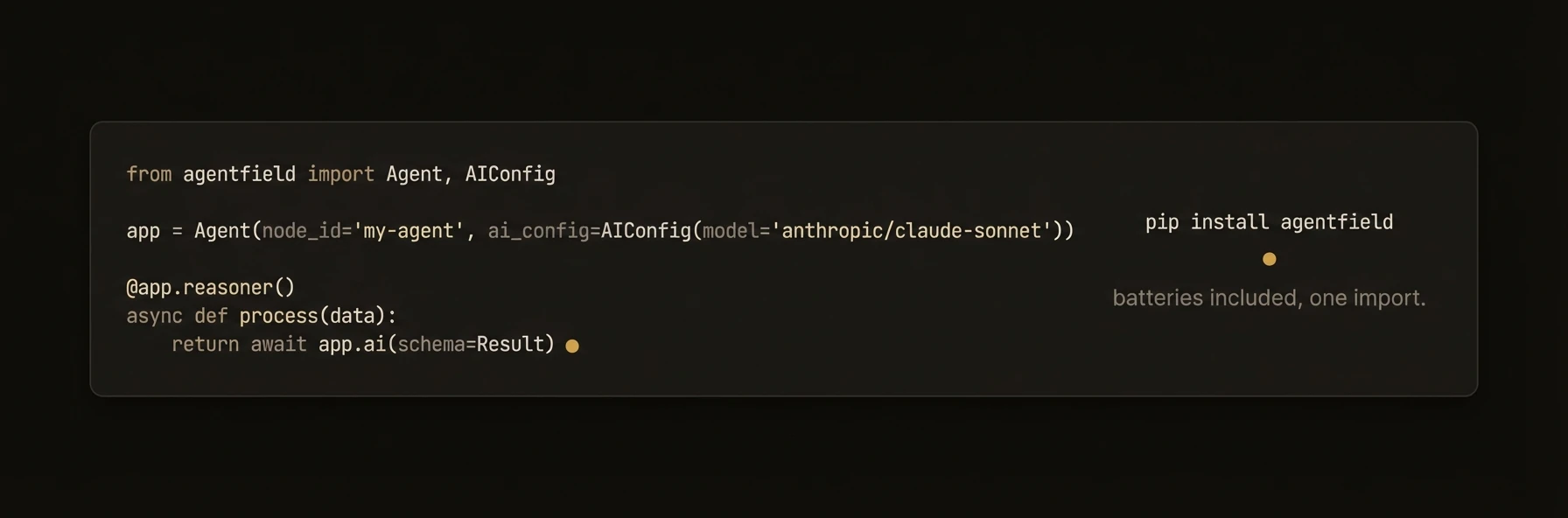
Build AI agents as production microservices with Python.
The Python SDK turns registered reasoners and skills into callable agent endpoints with routing, coordination, memory, async execution, and optional DID-backed governance. Identity and verifiable-credential features are available when you enable them.
Install
pip install agentfieldRequires Python 3.10–3.13.
Quick Start
from agentfield import Agent, AIConfig
from pydantic import BaseModel

app = Agent(
    node_id="my-agent",
    ai_config=AIConfig(model="anthropic/claude-sonnet-4-20250514"),
)

class Summary(BaseModel):
    title: str
    key_points: list[str]

@app.reasoner()
async def summarize(text: str) -> dict:
    result = await app.ai(
        system="You are a concise summarizer.",
        user=text,
        schema=Summary,
    )
    return result.model_dump()

app.run()
Start the control plane and your agent:
af server          # Terminal 1 — Dashboard at http://localhost:8080
python app.py      # Terminal 2 — Agent auto-registers
Call your agent:
curl -X POST http://localhost:8080/api/v1/execute/my-agent.summarize \
  -H "Content-Type: application/json" \
  -d '{"input": {"text": "AgentField is an open-source control plane..."}}'
Agent Constructor and Environment Variables
Agent Constructor
from agentfield import Agent, AIConfig, HarnessConfig, MemoryConfig

app = Agent(
    node_id="my-agent",                           # Required — unique agent identifier
    agentfield_server="http://localhost:8080",     # Control plane URL (default: env or localhost:8080)
    version="1.0.0",                               # Agent version string
    description="My agent description",            # Human-readable description
    tags=["nlp", "production"],                    # Organizational tags
    author={"name": "Team", "email": "a@b.com"},  # Author metadata
    ai_config=AIConfig(...),                       # LLM configuration
    harness_config=HarnessConfig(...),             # Coding agent configuration (defaults to aforge)
    memory_config=MemoryConfig(...),               # Memory behavior configuration
    dev_mode=False,                                # Enable verbose debug logging
    async_config=None,                             # AsyncConfig for execution tuning
    callback_url=None,                             # Explicit callback URL for control plane
    auto_register=True,                            # Auto-register on first invocation
    vc_enabled=True,                               # Generate verifiable credentials
    api_key=None,                                  # API key for control plane auth
    enable_mcp=False,                              # Enable Model Context Protocol servers
    enable_did=True,                               # Enable decentralized identity
    local_verification=False,                      # Enable local DID signature verification
    verification_refresh_interval=300,             # DID verification refresh interval (seconds)
)
The Agent class extends FastAPI, so you can use all FastAPI features (middleware, dependency injection, lifespan events) alongside AgentField capabilities.
Environment Variables
| Variable | Purpose |
|---|---|
AGENTFIELD_SERVER | Primary control plane URL |
AGENTFIELD_SERVER_URL | Fallback control plane URL |
AGENT_CALLBACK_URL | Explicit callback URL for the agent |
Complete Method Reference
Complete Method Reference
Core Methods
| Method | Signature | Returns | Description |
|---|---|---|---|
ai | await app.ai(*args, system=, user=, schema=, model=, ...) | Any | LLM call with structured output support |
harness | await app.harness(prompt, schema=, ...) | HarnessResult | Dispatch harness work (AForge by default) |
call | await app.call(target, *args, **kwargs) | dict | Cross-agent function call |
pause | await app.pause(approval_request_id, ...) | ApprovalResult | Suspend execution for human approval |
note | app.note(message, tags=) | None | Fire-and-forget execution note |
discover | app.discover(agent=, tags=, ...) | DiscoveryResult | Discover agent capabilities |
run | app.run(**serve_kwargs) | None | Auto-detect CLI vs server mode |
serve | app.serve(port=, host=, dev=, ...) | None | Start the agent HTTP server |
Properties
| Property | Type | Description |
|---|---|---|
memory | MemoryInterface | None | Memory interface scoped to current execution context |
app.ai() — LLM Calls
app.ai() — LLM Calls
The universal AI method supports text, images, audio, and file inputs with intelligent type detection.
async def ai(
    *args: Any,                                    # Flexible inputs — text, URLs, bytes, dicts
    system: Optional[str] = None,                  # System prompt
    user: Optional[str] = None,                    # User message (alternative to positional args)
    schema: Optional[Type[BaseModel]] = None,      # Pydantic model for structured output
    model: Optional[str] = None,                   # Override model (e.g., "gpt-4o", "claude-3")
    temperature: Optional[float] = None,           # Creativity (0.0-2.0)
    max_tokens: Optional[int] = None,              # Maximum response length
    stream: Optional[bool] = None,                 # Enable streaming
    response_format: Optional[str | Dict] = None,  # "auto", "json", or "text"
    context: Optional[Dict] = None,                # Additional context for the LLM
    memory_scope: Optional[List[str]] = None,      # Memory scopes to inject
    tools: Optional[...] = None,                   # Tool definitions for tool calling
    max_turns: Optional[int] = None,               # Max LLM turns in tool-call loop (default: 10)
    max_tool_calls: Optional[int] = None,          # Max total tool calls (default: 25)
    **kwargs,                                      # Additional provider-specific parameters
) -> Any
Examples
# Simple text
response = await app.ai("Summarize this document.")

# System + user prompts
response = await app.ai(
    system="You are a helpful assistant.",
    user="What is the capital of France?",
)

# Structured output with Pydantic
class Sentiment(BaseModel):
    sentiment: str
    confidence: float

result = await app.ai(
    "Analyze sentiment of: I love this!",
    schema=Sentiment,
)
print(result.sentiment)      # "positive"
print(result.confidence)     # 0.95

# Multimodal — image + text
response = await app.ai(
    "Describe this image:",
    "https://example.com/photo.jpg",
)

# Tool calling with auto-discovery
response = await app.ai(
    system="You are a helpful assistant with access to tools.",
    user="What agents are available?",
    tools="discover",
)
Tool Calling
The tools parameter accepts multiple formats:
| Value | Behavior |
|---|---|
"discover" | Auto-discover all tools from the control plane |
ToolCallConfig(...) | Discover with filtering and progressive options |
List[dict] | Raw OpenAI-format tool schemas |
List[ReasonerCapability | SkillCapability] | Pre-fetched capability objects |
from agentfield import ToolCallConfig

result = await app.ai(
    user="Process this claim",
    tools=ToolCallConfig(
        max_turns=5,
        max_tool_calls=10,
        tags=["insurance"],
        agent_ids=["claims-processor"],
    ),
)
app.harness() — Harness orchestration
app.harness() — Harness orchestration
Dispatch tasks to a coding agent with tool access, structured output, and runtime limits.
With no provider, the call runs AForge — AgentField's native harness,
installed alongside the af binary, so there is nothing extra to set up beyond OPENROUTER_API_KEY.
Pass provider= to drive Claude Code, Codex, Gemini CLI, OpenCode, or Grok (Python SDK only)
instead. Precedence: an explicit provider argument, then the agent's HarnessConfig, then
AGENTFIELD_HARNESS_PROVIDER, then "aforge".
async def harness(
    prompt: str,                                    # Task description
    *,
    schema: Any = None,                             # Pydantic model for structured output
    provider: Optional[str] = None,                 # None -> "aforge"; else "claude-code", "codex", "gemini", "opencode", "grok"
    model: Optional[str] = None,                    # None -> the provider's own default model
    max_turns: Optional[int] = None,                # Maximum agent iterations
    max_budget_usd: Optional[float] = None,         # Cost cap in USD (claude-code only)
    tools: Optional[List[str]] = None,              # Allowed tools (claude-code only)
    permission_mode: Optional[str] = None,          # "plan", "auto", or None (claude-code, codex, gemini)
    system_prompt: Optional[str] = None,            # System prompt for the agent
    env: Optional[Dict[str, str]] = None,           # Environment variables
    cwd: Optional[str] = None,                      # Working directory
    **kwargs,
) -> HarnessResult
HarnessResult
| Field | Type | Description |
|---|---|---|
result | str | None | Raw text output from the harness provider |
parsed | Any | Validated schema object (if schema was provided) |
is_error | bool | Whether the execution errored |
error_message | str | None | Error details if is_error is True |
cost_usd | float | None | Execution cost in USD |
num_turns | int | Number of agent iterations |
duration_ms | int | Execution duration in milliseconds |
session_id | str | Session identifier |
messages | List[Dict] | Full message history |
text | str | Property — alias for result (returns "" if None) |
Example
from pydantic import BaseModel

class CodeReview(BaseModel):
    issues: list[str]
    suggestions: list[str]
    score: int

# No provider, no model — this runs on AForge, the default harness.
result = await app.harness(
    "Review the Python code in ./src for security issues",
    schema=CodeReview,
    max_turns=20,
    cwd="/path/to/project",
)

print(result.parsed.score)       # 85
print(result.cost_usd)           # 0.23
app.call() — Cross-Agent Communication
app.call() — Cross-Agent Communication
Route calls to other agents through the control plane. Always returns dict (like a REST API).
async def call(
    target: str,       # "node_id.function_name"
    *args,             # Positional arguments (auto-mapped to parameter names)
    **kwargs,          # Keyword arguments
) -> dict
Examples
# Keyword arguments (recommended)
result = await app.call(
    "sentiment-agent.analyze",
    message="I love this product!",
    customer_id="cust_123",
)

# Positional arguments
result = await app.call(
    "notification-agent.send_email",
    "user@example.com",       # to
    "Welcome!",               # subject
    body="Thanks for joining.",
)
app.pause() — Human-in-the-Loop
app.pause() — Human-in-the-Loop
Suspend execution until a human approves, rejects, or requests changes.
async def pause(
    approval_request_id: str,            # ID of the approval request
    approval_request_url: str = "",      # URL where humans review the request
    expires_in_hours: int = 72,          # Expiry time
    timeout: Optional[float] = None,     # Max seconds to wait
    execution_id: Optional[str] = None,  # Override current execution ID
) -> ApprovalResult
ApprovalResult
| Field | Type | Description |
|---|---|---|
decision | str | "approved", "rejected", "request_changes", "expired", or "error" |
feedback | str | Human's feedback text |
execution_id | str | The execution that was paused |
approval_request_id | str | The approval request identifier |
approved | bool | Property — True if decision == "approved" |
Decorators, Memory, and Configuration
Decorators
@app.reasoner()
Register an AI-powered function.
@app.reasoner(
    path=None,                             # Custom endpoint path
    name=None,                             # Explicit registration ID
    tags=None,                             # Organizational tags
    vc_enabled=None,                       # Override VC generation
    require_realtime_validation=False,     # Require real-time VC validation
)
@app.skill()
Register a deterministic function.
@app.skill(
    tags=None,                             # Organizational tags
    path=None,                             # Custom endpoint path
    name=None,                             # Explicit registration ID
    vc_enabled=None,                       # Override VC generation
    require_realtime_validation=False,     # Require real-time VC validation
)
Both decorators automatically generate input/output schemas from type hints, create FastAPI endpoints with validation, integrate with workflow tracking, and enable cross-agent communication via app.call().
@app.session()
Register a realtime or multimodal session entrypoint. Sessions start through the AgentField control plane, while session tools still route into normal reasoners and workflow DAGs.
@app.session(
    "voice",
    provider="openai",
    transport="webrtc",
    model="gpt-realtime-2",
    modalities=["audio", "text"],
    voice="marin",
    tools=["voice-support-af.resolve_voice_turn"],
    tags=["support:voice", "pii:limited"],
)
async def voice(session):
    turn = await session.input()
    result = await session.call("voice-support-af.resolve_voice_turn", turn=turn)
    await session.say(result["spoken_response"])
Provider and transport are explicit. AgentField validates the combination and does not infer or switch providers.
tools=[...] is a provider/client-visible allowlist, not a requirement for the handler to call reasoners. The handler can always orchestrate with session.call(...); tools exposes selected AgentField targets for autonomous realtime tool calls during the live session.
tags=[...] proposes access-control tags for the session ingress. Approve them like reasoner and skill tags, then use policies to control who can start the live session.
Memory
The app.memory property provides a MemoryInterface scoped to the current execution context.
Memory Scopes
| Scope | Lifetime | Use For |
|---|---|---|
global | Until explicitly deleted | Shared config, knowledge bases |
session | Until session ends | Conversation context, user preferences |
actor | Persists across sessions | Actor-specific learned data |
workflow | Until workflow run completes | Intermediate results, per-run state |
MemoryInterface Methods
# Basic key-value operations
await app.memory.set(key: str, data: Any) -> None
await app.memory.get(key: str, default: Any = None) -> Any
await app.memory.exists(key: str) -> bool
await app.memory.delete(key: str) -> None

# Vector operations
await app.memory.set_vector(key, embedding, metadata=None)
await app.memory.delete_vector(key)
await app.memory.similarity_search(query_embedding, top_k=10, filters=None)

# Scoped access
app.memory.session(session_id) -> ScopedMemoryClient
app.memory.actor(actor_id) -> ScopedMemoryClient
app.memory.workflow(workflow_id) -> ScopedMemoryClient

# Reactive events
@app.memory.on_change("user.*")
async def on_user_change(event):
    print(f"Key {event.key} changed: {event.data}")
Configuration Classes
AIConfig
from agentfield import AIConfig

config = AIConfig(
    model="gpt-4o",                          # Default LLM model
    temperature=None,                        # 0.0-2.0
    max_tokens=None,                         # Max response length
    fallback_models=[],                      # Fallback model list
    enable_rate_limit_retry=True,            # Auto-retry on rate limits
    max_cost_per_call=None,                  # Max cost per call in USD
    daily_budget=None,                       # Daily budget in USD
    auto_inject_memory=[],                   # Memory scopes to auto-inject
    litellm_params={},                       # Additional LiteLLM parameters
)
HarnessConfig
from agentfield import HarnessConfig

config = HarnessConfig(
    # provider defaults to "aforge" — omit it for the zero-setup default.
    # Override with "claude-code", "codex", "gemini", "opencode", or "grok".
    model=None,                              # None -> the provider's own default model
    max_turns=30,                            # Maximum agent iterations
    max_budget_usd=None,                     # Cost cap in USD (claude-code only)
    max_retries=3,                           # Retry attempts
    tools=["Read", "Write", "Edit", "Bash", "Glob", "Grep"],  # claude-code only
    permission_mode=None,                    # "plan", "auto", or None (claude-code, codex, gemini)
)
MemoryConfig
from agentfield import MemoryConfig

config = MemoryConfig(
    auto_inject=["workflow", "session"],     # Required — memory scopes to auto-inject
    memory_retention="session",              # Required — retention policy
    cache_results=True,                      # Required — cache memory results locally
)
AgentRouter, Exceptions, and Complete Example
AgentRouter
Organize reasoners and skills into modular routers, similar to FastAPI's APIRouter.
from agentfield import Agent, AgentRouter

user_router = AgentRouter(prefix="/users", tags=["users"])

@user_router.reasoner()
async def analyze_behavior(user_id: str) -> dict:
    ...

@user_router.skill()
async def get_profile(user_id: str) -> dict:
    ...

app = Agent(node_id="my-agent")
app.include_router(user_router)
Exceptions
from agentfield import (
    AgentFieldError,           # Base exception
    AgentFieldClientError,     # Control plane request failures
    ExecutionTimeoutError,     # Execution timeout
    MemoryAccessError,         # Memory backend failures
    RegistrationError,         # Agent registration failures
    ValidationError,           # Input validation failures
)
Complete Example
from agentfield import Agent, AIConfig, HarnessConfig
from pydantic import BaseModel

app = Agent(
    node_id="claims-processor",
    version="2.1.0",
    ai_config=AIConfig(model="anthropic/claude-sonnet-4-20250514"),
    tags=["insurance", "critical"],
)

class Decision(BaseModel):
    action: str         # "approve", "deny", "escalate"
    confidence: float
    reasoning: str

@app.reasoner(tags=["insurance", "critical"])
async def evaluate_claim(claim: dict) -> dict:
    await app.memory.set("current_claim", claim)

    decision = await app.ai(
        system="Insurance claims adjuster. Evaluate and decide.",
        user=f"Claim #{claim['id']}: {claim['description']}",
        schema=Decision,
    )

    app.note(f"Decision: {decision.action} ({decision.confidence})", ["audit"])

    if decision.confidence < 0.85:
        approval = await app.pause(
            approval_request_id=f"claim-{claim['id']}",
            approval_request_url=f"https://internal.acme.com/approvals/{claim['id']}",
            expires_in_hours=48,
        )
        if not approval.approved:
            return {"action": "rejected", "feedback": approval.feedback}

    await app.call("notifier.send_decision",
        claim_id=claim["id"],
        decision=decision.model_dump(),
    )

    return decision.model_dump()

app.run()