Reasoners
AI-powered functions with automatic workflow tracking, schema generation, and execution context
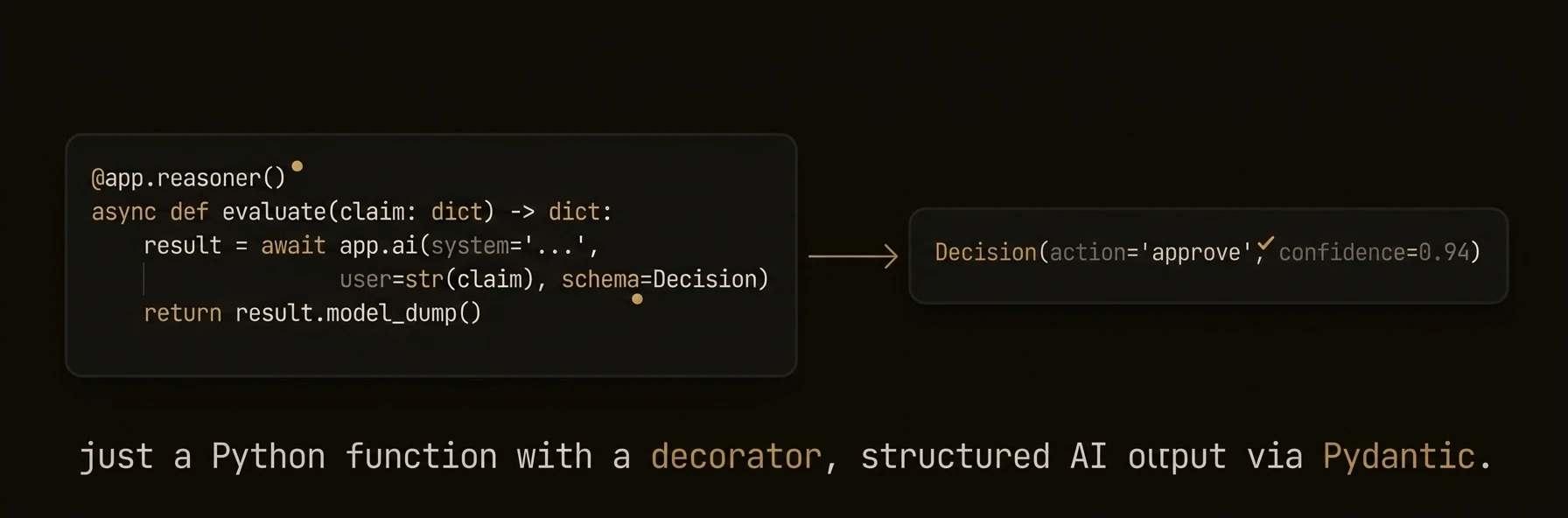
AI-powered functions that turn LLM calls into typed, tracked, auditable API endpoints.
The real production problem is not “how do I call a model?” It is “which parts of this workflow need AI judgment, and which parts need deterministic control?” Reasoners are where that boundary lives.
They are not just LLM wrappers. A reasoner combines AI analysis with your routing, validation, escalation, and side effects, then runs that workflow with full execution context and auditability.
from agentfield import Agent, AIConfig
from pydantic import BaseModel

app = Agent(
    node_id="support-triage",
    ai_config=AIConfig(model="anthropic/claude-sonnet-4-20250514"),
)

class TriageDecision(BaseModel):
    priority: str
    team: str
    escalate: bool
    reasoning: str

@app.reasoner(tags=["support", "triage"])
async def triage_ticket(subject: str, body: str, account_tier: str) -> dict:
    decision = await app.ai(
        system="You triage support tickets for urgency, routing, and escalation risk.",
        user=f"Tier: {account_tier}\nSubject: {subject}\n\n{body}",
        schema=TriageDecision,
    )

    if decision.escalate:
        await app.call("escalation.create_case",
            subject=subject, priority=decision.priority, reasoning=decision.reasoning)

    app.note(
        f"Triage decision priority={decision.priority} team={decision.team}",
        ["triage", decision.priority],
    )

    return decision.model_dump()
What just happened
- AI produced a typed triage decision instead of free-form text
- Your code handled the escalation side effect deterministically
- The reasoner emitted an execution note for observability
- AgentField attached execution IDs, workflow context, and an HTTP target automatically
Example target and result shape:
{
  "target": "support-triage.triage_ticket",
  "execution_id": "exec_a1b2c3",
  "result": {
    "priority": "critical",
    "team": "support-engineering",
    "escalate": true,
    "reasoning": "Enterprise customer reporting data loss"
  }
}
What You Get
- Automatic REST endpoints generated from function signatures and type hints
- Workflow tracking with execution IDs, parent-child relationships, and DAG building
- Schema generation from type annotations (Python) or explicit schemas (TypeScript, Go)
- Execution context with run ID, session, memory access, and cross-agent call propagation
- Verifiable credentials for every execution when DID is enabled
- Pydantic model conversion (Python) for automatic input validation
Patterns
Execution context injection (Python)
When your reasoner function declares an execution_context parameter, the SDK automatically injects it:
from agentfield.execution_context import ExecutionContext

@app.reasoner()
async def traced_operation(data: str, execution_context: ExecutionContext = None) -> dict:
    print(f"Run ID: {execution_context.run_id}")
    print(f"Execution ID: {execution_context.execution_id}")
    print(f"Depth: {execution_context.depth}")

    # Child context propagates to downstream calls
    return {"data": data, "run_id": execution_context.run_id}
Pydantic input validation (Python)
Reasoners automatically convert incoming JSON to Pydantic models when type hints are used:
from pydantic import BaseModel, Field

class AnalysisRequest(BaseModel):
    text: str = Field(..., min_length=1)
    language: str = Field(default="en", pattern="^[a-z]{2}$")
    max_tokens: int = Field(default=500, ge=1, le=4096)

@app.reasoner(tags=["analysis"])
async def analyze(request: AnalysisRequest) -> dict:
    # request is already validated -- invalid input returns 422
    result = await app.ai(
        system=f"Analyze in {request.language}.",
        user=request.text,
    )
    return result
CLI-accessible reasoners (Go)
The Go SDK supports running reasoners directly from the command line:
a.RegisterReasoner("greet", func(ctx context.Context, input map[string]any) (any, error) {
    name, _ := input["name"].(string)
    return map[string]any{"message": fmt.Sprintf("Hello, %s!", name)}, nil
},
    agent.WithCLI(),
    agent.WithDefaultCLI(),
    agent.WithDescription("Greet a user by name"),
)

// Run with: go run main.go greet --name Alice
// Or start server: go run main.go serve
a.Run(context.Background())
Registration Options
Python @app.reasoner() decorator
| Parameter | Type | Default | Description |
|---|---|---|---|
path | str | None | "/reasoners/{fn_name}" | Custom API endpoint path |
name | str | None | function name | Explicit registration ID |
tags | list[str] | None | None | Organizational tags for discovery and policy |
vc_enabled | bool | None | None | Override agent-level VC generation |
require_realtime_validation | bool | False | Force control-plane verification |
The standalone @reasoner decorator (from agentfield.decorators) adds track_workflow and description parameters and is used for module-level reasoners outside the agent decorator pattern.
TypeScript agent.reasoner() options
| Parameter | Type | Default | Description |
|---|---|---|---|
tags | string[] | undefined | Organizational tags |
description | string | undefined | Human-readable description |
inputSchema | any | undefined | JSON Schema for input validation |
outputSchema | any | undefined | JSON Schema for output documentation |
trackWorkflow | boolean | undefined | Enable workflow tracking |
requireRealtimeValidation | boolean | undefined | Force control-plane verification |
Go RegisterReasoner() options
| Option | Description |
|---|---|
WithDescription(desc) | Human-readable description for help and discovery |
WithReasonerTags(tags...) | Tags for organization and tag-based authorization |
WithInputSchema(json.RawMessage) | Override auto-generated input schema |
WithOutputSchema(json.RawMessage) | Override default output schema |
WithVCEnabled(bool) | Override agent-level VC generation |
WithCLI() | Make this reasoner accessible from the CLI |
WithDefaultCLI() | Set as the default CLI handler |
WithCLIFormatter(func) | Custom output formatter for CLI mode |
WithRequireRealtimeValidation() | Force control-plane verification |
SDK Reference
| Operation | Python | TypeScript | Go |
|---|---|---|---|
| Register | @app.reasoner() | agent.reasoner(name, handler, opts?) | a.RegisterReasoner(name, handler, opts...) |
| Handler signature | async def fn(arg: Type) -> Type | (ctx: ReasonerContext) => Promise<T> | func(ctx, input map[string]any) (any, error) |
| Access input | Function parameters | ctx.input | input map |
| Access AI | await app.ai(...) | await ctx.ai(...) | a.AI(ctx, ...) |
| Cross-agent call | await app.call(target, input) | await ctx.call(target, input) | a.Call(ctx, target, input) |
| Access memory | app.memory.set(key, val) | ctx.memory.set(key, val) | a.Memory().Set(ctx, key, val) |
| Get execution context | execution_context parameter | ctx.executionId, ctx.runId | agent.ExecutionContextFrom(ctx) |