AI generation
Text generation and structured output with app.ai(), the universal method for LLM calls
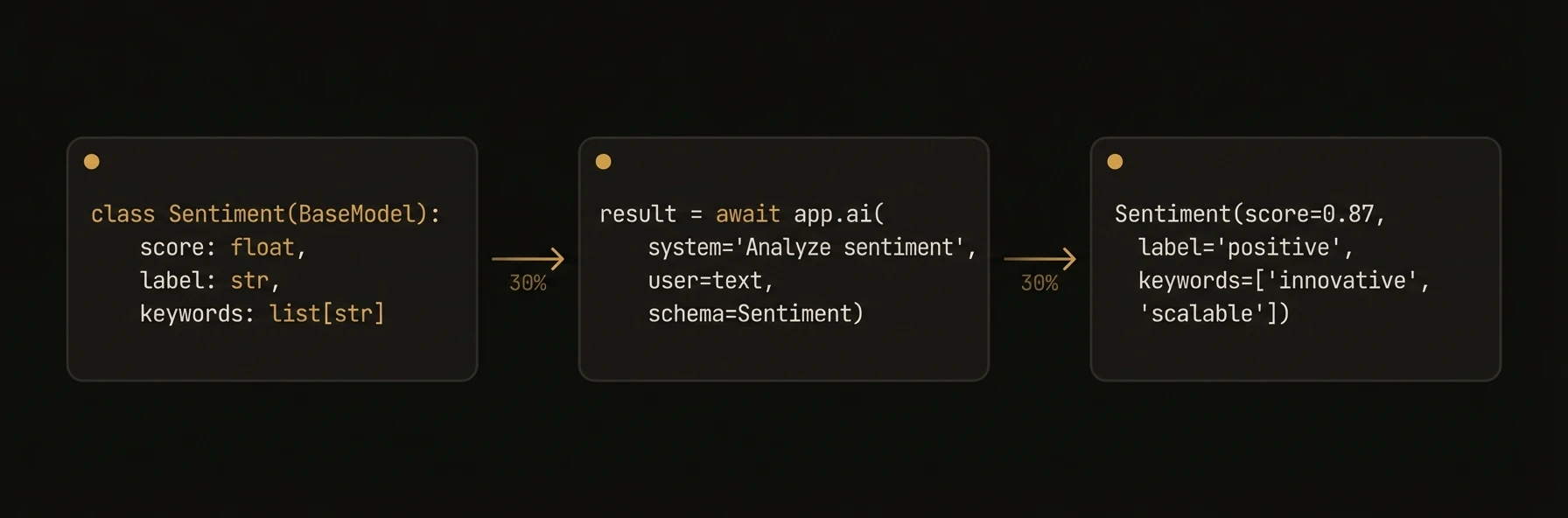
Call any LLM with a single method. Pass a prompt, get text back. Pass a schema, get a validated object back. Override the model, temperature, or any other parameter per-call without changing your agent config. Works with 100+ models via LiteLLM (Python), Vercel AI SDK (TypeScript), or OpenAI-compatible APIs (Go).
from pydantic import BaseModel

class LeadScore(BaseModel):
    score: float          # 0-100 likelihood to convert
    reasoning: str        # why this score
    next_action: str      # recommended sales action
    urgency: str          # "high" | "medium" | "low"

# Structured output — pass a schema, get a validated typed object back
lead = await app.ai(
    system="You are a B2B sales analyst scoring inbound leads.",
    user="Company: Acme Corp, 500 employees, viewed pricing page 3x this week",
    schema=LeadScore,
)
print(lead.score)        # 82.5  — not a string, a float
print(lead.next_action)  # "Schedule demo within 24 hours"

# Override model per-call — cheap model for fast classification
category = await app.ai(
    user=ticket_text,
    schema=TicketCategory,
    model="openai/gpt-4o-mini",        # 10x cheaper, good enough for routing
)

# Powerful model for deep analysis — same method, different model
analysis = await app.ai(
    system="Provide root cause analysis with remediation steps.",
    user=ticket_text,
    schema=RootCauseAnalysis,
    model="anthropic/claude-sonnet-4-20250514",  # best reasoning for hard problems
)

# Streaming — real-time token delivery for interactive UIs
response = await app.ai(
    system="Write a detailed post-mortem.",
    user=incident_summary,
    stream=True,
)
async for chunk in response:
    print(chunk.choices[0].delta.content, end="")

# Automatic fallback chain — if primary model fails, try the next
app = Agent(
    node_id="resilient-agent",
    ai_config=AIConfig(
        model="anthropic/claude-sonnet-4-20250514",
        fallback_models=["openai/gpt-4o", "deepseek/deepseek-chat"],
        max_cost_per_call=0.05,         # hard cost cap per call
    ),
)
What just happened
The same ai() call handled three common production modes without changing your surrounding code: typed extraction with a schema, a cheap model override for simple classification, and a stronger model override for deeper analysis. The page’s main point is that you do not need separate client stacks for each of those paths.
{
  "lead_score": {
    "score": 8.7,
    "next_action": "schedule_demo"
  },
  "ticket_category": {
    "category": "billing"
  },
  "analysis": {
    "root_cause": "misconfigured webhook retry policy"
  }
}
What You Get
- Text generation from 100+ LLMs via a single method call
- Structured output validated against Pydantic models (Python), Zod schemas (TypeScript), or Go structs
- Automatic prompt trimming to fit model context windows
- Rate limit retry with exponential backoff and circuit breaker
- Model fallbacks when primary model fails
- Streaming for real-time token delivery
- Multimodal input auto-detection for images, audio, and files
Patterns
System + User Prompts
The most common pattern separates instruction from input.
response = await app.ai(
    system="You are a senior code reviewer. Be concise and actionable.",
    user=code_diff,
)
Structured Output
Schema-validated output eliminates parsing and handles malformed JSON automatically.
class RiskAssessment(BaseModel):
    risk_level: str          # "low", "medium", "high", "critical"
    confidence: float        # 0.0-1.0
    findings: list[str]
    recommendation: str

assessment = await app.ai(
    system="Assess security risk in the following code.",
    user=source_code,
    schema=RiskAssessment,
    model="anthropic/claude-sonnet-4-20250514",
    temperature=0.0,  # Deterministic for security analysis
)

if assessment.risk_level == "critical":
    await escalate(assessment)
Model Override Per Call
Use different models for different tasks without reconfiguring the agent.
# Fast model for classification
category = await app.ai(
    user=ticket_text,
    schema=TicketCategory,
    model="openai/gpt-4o-mini",
)

# Powerful model for deep analysis
analysis = await app.ai(
    system="Provide a thorough root cause analysis.",
    user=ticket_text,
    schema=RootCauseAnalysis,
    model="anthropic/claude-sonnet-4-20250514",
)
Streaming
Stream tokens in real-time for interactive applications.
response = await app.ai(
    system="Write a detailed technical blog post.",
    user="Topic: Building multi-agent systems",
    stream=True,
)
# response is a LiteLLM streaming object
async for chunk in response:
    print(chunk.choices[0].delta.content, end="")
Model Fallbacks
Configure automatic fallback to alternative models when the primary fails.
app = Agent(
    node_id="resilient-agent",
    ai_config=AIConfig(
        model="anthropic/claude-sonnet-4-20250514",
        fallback_models=[
            "openai/gpt-4o",
            "openrouter/google/gemini-2.5-flash",
        ],
        enable_rate_limit_retry=True,
        rate_limit_max_retries=5,
    ),
)
If the primary model hits a rate limit or returns an error, the SDK automatically tries each fallback in order.
Rate Limit Configuration
Fine-tune retry behavior for rate limits and transient errors via AIConfig.
app = Agent(
    node_id="high-throughput-agent",
    ai_config=AIConfig(
        model="anthropic/claude-sonnet-4-20250514",
        enable_rate_limit_retry=True,

        # Retry tuning
        rate_limit_max_retries=10,             # max retry attempts (default: 5)
        rate_limit_base_delay=1.0,             # initial delay in seconds (default: 0.5)
        rate_limit_max_delay=60.0,             # cap on exponential backoff (default: 30.0)
        rate_limit_jitter_factor=0.5,          # random jitter 0.0-1.0 (default: 0.25)

        # Circuit breaker — stop retrying after repeated failures
        rate_limit_circuit_breaker_threshold=10,   # failures before tripping (default: 5)
        rate_limit_circuit_breaker_timeout=120.0,  # seconds before half-open retry (default: 30)
    ),
)| Field | Type | Default | Description |
|---|---|---|---|
rate_limit_max_retries | int | 5 | Maximum retry attempts before failing |
rate_limit_base_delay | float | 0.5 | Initial backoff delay in seconds |
rate_limit_max_delay | float | 30.0 | Maximum backoff delay cap |
rate_limit_jitter_factor | float | 0.25 | Random jitter factor (0.0 = none, 1.0 = full) |
rate_limit_circuit_breaker_threshold | int | 5 | Consecutive failures to trip the circuit breaker |
rate_limit_circuit_breaker_timeout | int | 30 | Seconds before attempting recovery |
Cost Management
Set hard cost limits to prevent runaway spending.
app = Agent(
    node_id="budget-agent",
    ai_config=AIConfig(
        model="anthropic/claude-sonnet-4-20250514",
        max_cost_per_call=0.05,       # estimated cost cap per individual call
        daily_budget=10.00,           # daily spend limit
    ),
)| Field | Type | Default | Description |
|---|---|---|---|
max_cost_per_call | float | None | Maximum estimated cost per individual AI call |
daily_budget | float | None | Maximum daily spend across all calls (resets at midnight UTC) |
Memory Scope Injection
Use memory_scope to automatically inject memory context into AI calls. The SDK fetches the specified scopes and appends their contents to the system prompt.
@app.reasoner()
async def chat(message: str) -> dict:
    # Inject session memory and actor memory into the AI call
    response = await app.ai(
        system="You are a helpful assistant. Use the provided context.",
        user=message,
        memory_scope=["session", "actor"],  # auto-fetches and injects memory
    )
    return {"response": response}

# Equivalent to manually doing:
# session_data = await app.memory.session(session_id).get("context")
# actor_data = await app.memory.actor(actor_id).get("preferences")
# then appending them to the system prompt
Method Signatures
Python
async def ai(
    *args,                                         # Flexible inputs (text, URLs, bytes, dicts)
    system: Optional[str] = None,                  # System prompt
    user: Optional[str] = None,                    # User message (alternative to positional args)
    schema: Optional[Type[BaseModel]] = None,      # Pydantic model for structured output
    model: Optional[str] = None,                   # Override model (e.g., "openai/gpt-4o")
    temperature: Optional[float] = None,           # Creativity (0.0-2.0)
    max_tokens: Optional[int] = None,              # Maximum response length
    stream: Optional[bool] = None,                 # Enable streaming
    response_format: Optional[str | Dict] = None,  # "auto", "json", or "text"
    memory_scope: Optional[List[str]] = None,      # Memory scopes to inject
    tools: Optional[...] = None,                   # Tool definitions (see Tool Calling page)
    max_turns: Optional[int] = None,               # Max LLM turns in tool-call loop
    max_tool_calls: Optional[int] = None,          # Max total tool calls
    **kwargs,                                      # Provider-specific parameters
) -> Any
TypeScript
AI methods are accessed via ctx inside reasoner/skill handlers:
// Inside a reasoner or skill handler:
async ctx.ai<T>(prompt: string, options?: {
  system?: string;                              // System prompt
  schema?: ZodSchema<T>;                        // Zod schema for structured output
  model?: string;                               // Override model
  temperature?: number;                         // Creativity (0.0-2.0)
  maxTokens?: number;                           // Maximum response length
  provider?: AIConfig['provider'];              // Override provider
  mode?: 'auto' | 'json' | 'tool';             // Structured output mode
}): Promise<T | string>

async ctx.aiStream(prompt: string, options?: AIRequestOptions): Promise<AIStream>

async ctx.aiWithTools(prompt: string, config: ToolCallConfig): Promise<ToolCallResponse>
Go
func (c *Client) Complete(
    ctx context.Context,
    prompt string,
    opts ...Option,
) (*Response, error)
Options: WithSystem(s), WithModel(m), WithTemperature(t), WithMaxTokens(n), WithStream(), WithSchema(struct), WithJSONMode(), WithAPIKey(k)
SDK Reference
| Feature | Python | TypeScript | Go |
|---|---|---|---|
| Method | await app.ai(...) | await ctx.ai(...) | client.Complete(ctx, ...) |
| Schema type | Pydantic BaseModel | Zod z.object(...) | Go struct with json tags |
| Streaming | stream=True | ctx.aiStream(...) | ai.WithStream() |
| System prompt | system="..." | { system: "..." } | ai.WithSystem("...") |
| Model override | model="openai/gpt-4o" | { model: "gpt-4o" } | ai.WithModel("gpt-4o") |
| Temperature | temperature=0.7 | { temperature: 0.7 } | ai.WithTemperature(0.7) |
| Max tokens | max_tokens=1000 | { maxTokens: 1000 } | ai.WithMaxTokens(1000) |
| JSON mode | response_format="json" | { mode: 'json' } | ai.WithJSONMode() |
| Rate limit retry | Built-in (configurable) | Built-in (configurable) | Manual |
| Embeddings | Via LiteLLM | Via AIClient.embed(...) | N/A |