Skills
Deterministic functions for business logic, integrations, and data processing
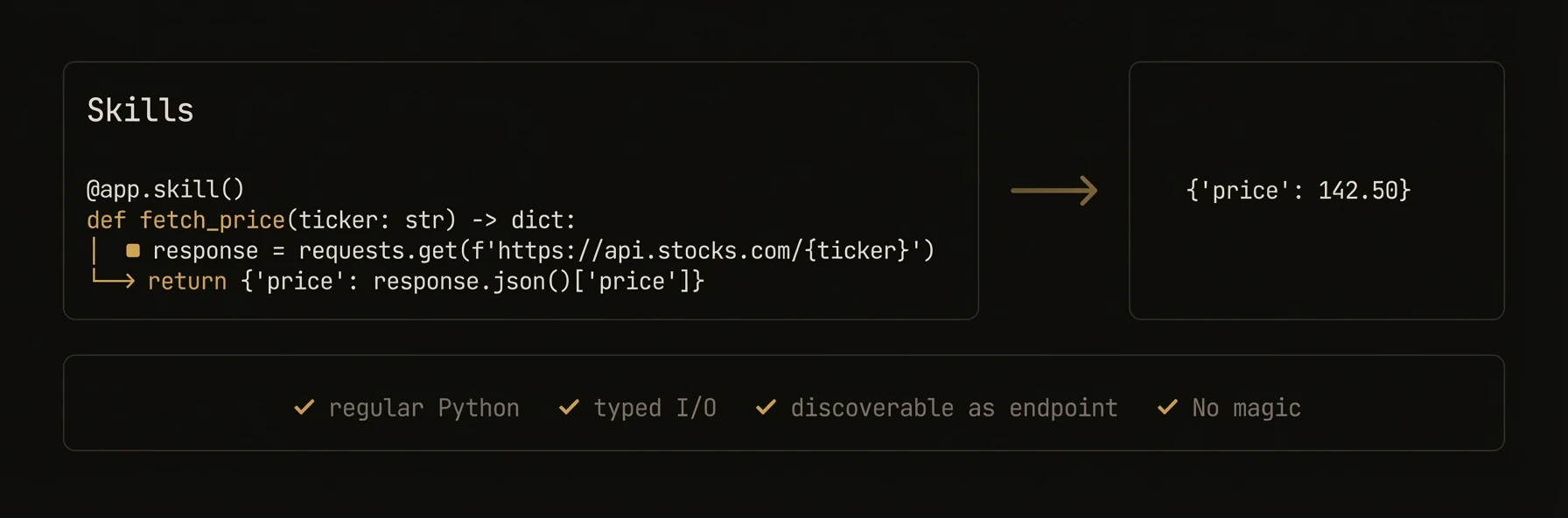
Deterministic functions for business logic that need the same infrastructure as reasoners -- without the AI.
This separation matters in production. When something breaks, you want to know whether the failure came from AI judgment or deterministic code. Skills are where you put systems-of-record access, calculations, API calls, and repeatable side effects.
from agentfield import Agent
from pydantic import BaseModel

app = Agent(node_id="inventory-service", version="1.0.0")

class StockQuery(BaseModel):
    sku: str
    warehouse: str = "us-east"

@app.skill(tags=["database", "inventory"])
async def check_stock(query: StockQuery) -> dict:
    """Fetch deterministic inventory state."""
    row = await db.execute(
        "SELECT sku, qty, reserved FROM stock WHERE sku = $1 AND warehouse = $2",
        query.sku, query.warehouse,
    )
    if not row:
        return {"sku": query.sku, "available": 0, "status": "not_found"}
    available = row["qty"] - row["reserved"]
    return {"sku": query.sku, "available": available, "status": "in_stock" if available > 0 else "out_of_stock"}

@app.skill(tags=["integrations", "shipping", "policy"])
async def fulfillable_quote(sku: str, dest: str, weight_kg: float) -> dict:
    stock = await check_stock(StockQuery(sku=sku))
    if stock["available"] <= 0:
        return {"sku": sku, "fulfillable": False, "reason": "out_of_stock"}

    rates = await fedex_client.rate_quote(origin="us-east", dest=dest, weight=weight_kg)
    return {"sku": sku, "fulfillable": True, "rates": rates, "currency": "USD"}

app.run()
# → POST /skills/check_stock  — auto-generated REST endpoint with input validation
# → POST /skills/fulfillable_quote  — discoverable by any agent in the fleet
What just happened
- Skills handled deterministic state and policy logic without any model call
- The second skill composed the first skill into a production-shaped workflow
- Both skills inherited the same endpoint generation, discoverability, and execution tracking as reasoners
- In Go, the same deterministic pattern is registered with
RegisterReasonerand exposed under/reasoners/{name}instead of/skills/{name}
Example proof:
Python/TypeScript:
POST /skills/check_stock
POST /skills/fulfillable_quote
discoverable target: inventory-service.fulfillable_quote

Go:
POST /reasoners/check_stock
Skills vs Reasoners
| Aspect | Reasoner | Skill |
|---|---|---|
| Purpose | AI-powered inference and generation | Deterministic business logic |
| LLM calls | Typically uses app.ai() or app.harness() | Typically no LLM calls |
| Output | May vary across runs | Same input always produces same output |
| Use cases | Classification, generation, analysis | API calls, database ops, calculations, formatting |
| Endpoint prefix | /reasoners/{name} | /skills/{name} |
Both share the same execution infrastructure: workflow tracking, execution context, verifiable credentials, and cross-agent communication.
Patterns
Database integration skill
Skills are ideal for wrapping database queries with validation and consistent return shapes:
from pydantic import BaseModel
from typing import Optional

class UserQuery(BaseModel):
    user_id: str
    fields: list[str] = ["name", "email"]

@app.skill(tags=["database", "users"])
async def get_user(query: UserQuery) -> dict:
    # Skills can be async for I/O operations
    user = await db.users.find_one({"_id": query.user_id})
    if not user:
        return {"error": "User not found", "user_id": query.user_id}
    return {k: user.get(k) for k in query.fields if k in user}
MCP tool auto-registration (Python)
The Python SDK can automatically discover MCP servers and register their tools as skills:
app = Agent(
    node_id="mcp-bridge",
    enable_mcp=True,
)

# MCP tools are automatically discovered and registered as skills
# with the naming pattern: {server_alias}_{tool_name}
# Each tool gets a /skills/{skill_name} endpoint
Combining skills and reasoners
A common pattern is using skills for data retrieval and reasoners for AI analysis:
@app.skill(tags=["data"])
async def fetch_metrics(service: str, window: str = "24h") -> dict:
    metrics = await monitoring_api.query(service, window)
    return {"service": service, "metrics": metrics}

@app.reasoner(tags=["analysis"])
async def diagnose(service: str) -> dict:
    # Skill handles data retrieval (deterministic)
    metrics = await fetch_metrics(service, window="1h")

    # Reasoner handles AI analysis (non-deterministic)
    diagnosis = await app.ai(
        system="You are an SRE diagnosing service issues.",
        user=f"Analyze metrics for {service}: {metrics}",
    )
    return {"service": service, "diagnosis": diagnosis}
Registration Options
Python @app.skill() decorator
| Parameter | Type | Default | Description |
|---|---|---|---|
tags | list[str] | None | None | Organizational tags for discovery and policy |
path | str | None | "/skills/{fn_name}" | Custom API endpoint path |
name | str | None | function name | Explicit registration ID |
vc_enabled | bool | None | None | Override agent-level VC generation |
require_realtime_validation | bool | False | Force control-plane verification |
TypeScript agent.skill() options
| Parameter | Type | Default | Description |
|---|---|---|---|
tags | string[] | undefined | Organizational tags |
description | string | undefined | Human-readable description |
inputSchema | any | undefined | JSON Schema for input validation |
outputSchema | any | undefined | JSON Schema for output documentation |
requireRealtimeValidation | boolean | undefined | Force control-plane verification |
Go
The Go SDK does not distinguish between skills and reasoners at the registration level. All functions are registered with RegisterReasoner. Use tags to distinguish intent:
a.RegisterReasoner("my_skill", handler,
    agent.WithReasonerTags("skill", "deterministic"),
    agent.WithDescription("A deterministic operation"),
)
SDK Reference
| Operation | Python | TypeScript | Go |
|---|---|---|---|
| Register | @app.skill() | agent.skill(name, handler, opts?) | a.RegisterReasoner(name, handler) |
| Handler signature | def fn(arg: Type) -> Type | (ctx: SkillContext) => T | Promise<T> | func(ctx, input) (any, error) |
| Sync support | Yes (sync or async) | Yes (sync or async) | Sync only |
| Access input | Function parameters | ctx.input | input map |
| Access memory | app.memory.set(key, val) | ctx.memory.set(key, val) | a.Memory().Set(ctx, key, val) |
| Endpoint prefix | /skills/ | /skills/ | /reasoners/ |