---
title: "Agents"
description: "The core container that hosts reasoners, skills, and sessions, and connects to the AgentField control plane"
url: "https://agentfield.ai/docs/agentfield/build/building-blocks/agents"
canonical: "https://agentfield.ai/docs/agentfield/build/building-blocks/agents"
markdown_url: "https://agentfield.ai/llm/docs/agentfield/build/building-blocks/agents"
contract_version: "2026-03-24-v1"
docs_revision: "a2a2b0669dab"
product: "AgentField"
category: "building-blocks"
difficulty: "beginner"
keywords: ["agent", "container", "serve", "run", "lifecycle", "constructor", "config"]
last_modified: "2026-11-02T17:24:14.000Z"
ai_summary: "The core container that hosts reasoners, skills, and sessions, and connects to the AgentField control plane"
---
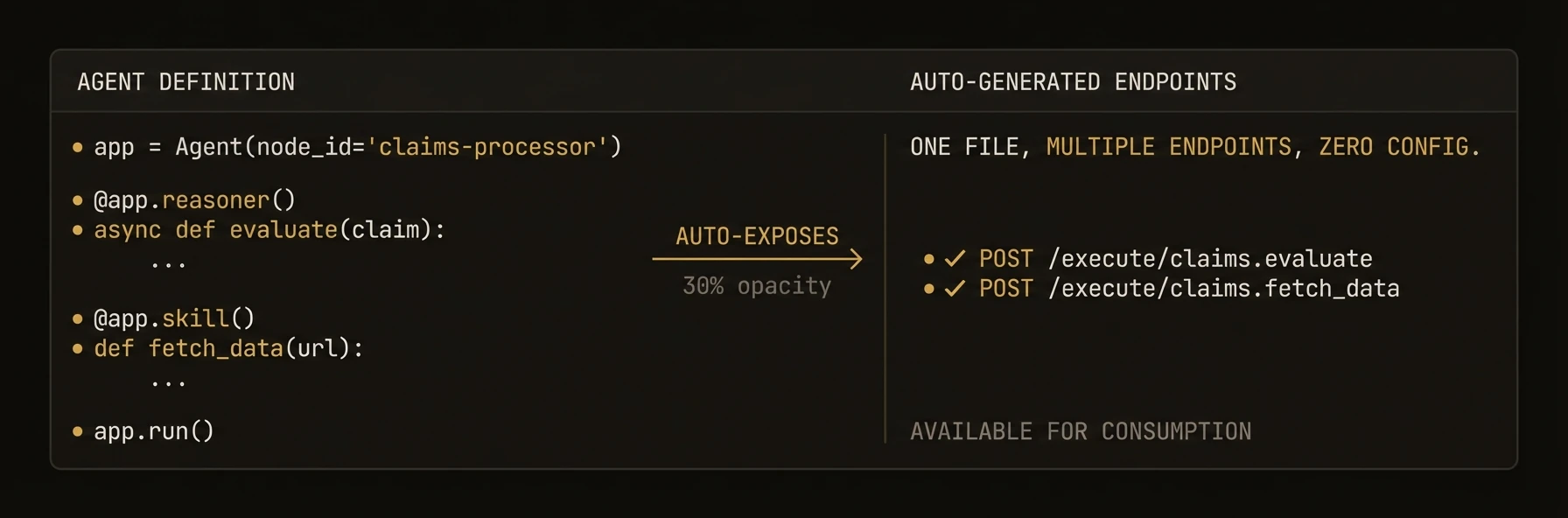 The top-level container that turns your code into a discoverable, governed, production microservice. An `Agent` instance hosts [reasoners](/docs/agentfield/build/building-blocks/reasoners), [skills](/docs/agentfield/build/building-blocks/skills), and [sessions](/docs/agentfield/build/building-blocks/sessions), and registers them with the control plane.
Without `Agent`, you would wire an HTTP server, registration, routing, identity, tracing, memory access, and cross-agent calls separately. With `Agent`, that infrastructure boundary is the object you instantiate.
### Python
```python
from agentfield import Agent, AIConfig
from pydantic import BaseModel
app = Agent(
node_id="support-triage", # unique ID in the network
ai_config=AIConfig(model="anthropic/claude-sonnet-4-20250514"),
)
class TicketClassification(BaseModel):
priority: str # "critical" | "high" | "normal" | "low"
department: str # route to the right team
summary: str # one-line summary for the queue
@app.reasoner() # AI-powered — gets an LLM client automatically
async def classify_ticket(subject: str, body: str, customer_id: str) -> TicketClassification:
result = await app.ai(
system="You triage customer support tickets.",
user=f"Subject: {subject}\n\n{body}",
schema=TicketClassification, # validated, typed output
)
await app.memory.set(f"ticket:{customer_id}:last_priority", result.priority)
return result
@app.skill() # deterministic — no AI, just business logic
def escalation_policy(priority: str) -> dict:
sla = {"critical": 15, "high": 60, "normal": 240, "low": 1440}
return {"sla_minutes": sla.get(priority, 240)}
app.run() # starts HTTP server + registers with control plane
# POST /reasoners/classify_ticket → AI classification
# POST /skills/escalation_policy → SLA lookup
```
### TypeScript
```typescript
import { Agent } from '@agentfield/sdk';
import { z } from 'zod';
const agent = new Agent({
nodeId: 'support-triage', // unique ID in the network
aiConfig: { provider: 'anthropic', model: 'claude-sonnet-4-20250514' },
});
const TicketClassification = z.object({
priority: z.enum(['critical', 'high', 'normal', 'low']),
department: z.string(), // route to the right team
summary: z.string(), // one-line summary for the queue
});
agent.reasoner('classifyTicket', async (ctx) => { // AI-powered
const result = await ctx.ai(
`Subject: ${ctx.input.subject}\n\n${ctx.input.body}`,
{
system: 'You triage customer support tickets.',
schema: TicketClassification, // validated, typed output
},
);
await ctx.memory.set(`ticket:${ctx.input.customerId}:lastPriority`, result.priority);
return result;
});
agent.skill('escalationPolicy', (ctx) => { // deterministic — no AI
const sla: Record = { critical: 15, high: 60, normal: 240, low: 1440 };
return { slaMinutes: sla[ctx.input.priority] ?? 240 };
});
agent.serve(); // starts HTTP server + registers with control plane
```
### Go
```go
package main
import (
"context"
"log"
"github.com/Agent-Field/agentfield/sdk/go/agent"
"github.com/Agent-Field/agentfield/sdk/go/ai"
)
func main() {
a, _ := agent.New(agent.Config{
NodeID: "support-triage", // unique ID in the network
Version: "1.0.0",
AgentFieldURL: "http://localhost:8080",
AIConfig: &ai.Config{Model: "anthropic/claude-sonnet-4-20250514"},
})
// AI-powered — gets an LLM client automatically
a.RegisterReasoner("classify_ticket", func(ctx context.Context, input map[string]any) (any, error) {
subject, _ := input["subject"].(string)
body, _ := input["body"].(string)
return map[string]any{"priority": "high", "department": "billing", "summary": subject}, nil
})
// Deterministic — no AI, just business logic
a.RegisterReasoner("escalation_policy", func(ctx context.Context, input map[string]any) (any, error) {
sla := map[string]int{"critical": 15, "high": 60, "normal": 240, "low": 1440}
priority, _ := input["priority"].(string)
return map[string]any{"sla_minutes": sla[priority]}, nil
})
log.Fatal(a.Run(context.Background())) // starts HTTP server + registers with control plane
}
```
---
**What just happened**
- One `Agent` instance exposed both AI and deterministic operations
- The reasoner got model access, validation, and workflow context automatically
- The deterministic function became a separate callable endpoint without extra server code
- In all three SDKs, deterministic endpoints can be registered separately from AI-powered reasoners
- The memory write used the same execution context as the reasoner
Example generated surface:
```text
Python/TypeScript:
POST /reasoners/classify_ticket
POST /skills/escalation_policy
target: support-triage.classify_ticket
Go equivalent:
POST /reasoners/classify_ticket
POST /skills/escalation_policy
```
### What You Get
- **HTTP server** with auto-generated REST endpoints for every reasoner and skill
- **Control plane registration** with heartbeat, lease renewal, and graceful shutdown
- **Cryptographic identity** via automatic DID registration and verifiable credentials
- **Cross-agent communication** through the AgentField execution gateway
- **Built-in AI client** for structured LLM output with any provider
- **Memory system** for distributed state across workflows and sessions
- **CLI mode** for local testing and interactive debugging
### Constructor Parameters
### Python
`Agent` extends FastAPI. All FastAPI constructor parameters are also accepted.
| Parameter | Type | Default | Description |
|-----------|------|---------|-------------|
| `node_id` | `str` | **required** | Unique identifier for this agent node |
| `agentfield_server` | `str \| None` | `"http://localhost:8080"` | Control plane URL. Also reads `AGENTFIELD_SERVER` env var |
| `version` | `str` | `"1.0.0"` | Agent version string |
| `description` | `str \| None` | `None` | Human-readable description |
| `tags` | `list[str] \| None` | `None` | Metadata labels for policy and discovery |
| `ai_config` | `AIConfig \| None` | `None` | LLM provider configuration |
| `harness_config` | `HarnessConfig \| None` | `None` | Configuration for the coding-agent harness. `None` or an unset `provider` means [CodeAF](/docs/agentfield/integrations/codeaf), the default. |
| `memory_config` | `MemoryConfig \| None` | `None` | Memory auto-injection, retention, and caching settings |
| `dev_mode` | `bool` | `False` | Enable verbose logging |
| `callback_url` | `str \| None` | auto-detected | URL the control plane uses to reach this agent |
| `auto_register` | `bool` | `True` | Register with control plane on startup |
| `vc_enabled` | `bool \| None` | `True` | Enable verifiable credential generation |
| `api_key` | `str \| None` | `None` | API key for control plane auth |
| `enable_mcp` | `bool` | `False` | Enable MCP server integration |
| `enable_did` | `bool` | `True` | Enable DID-based identity |
| `local_verification` | `bool` | `False` | Enable decentralized request verification |
### TypeScript
| Parameter | Type | Default | Description |
|-----------|------|---------|-------------|
| `nodeId` | `string` | **required** | Unique identifier for this agent node |
| `agentFieldUrl` | `string` | `"http://localhost:8080"` | Control plane URL |
| `port` | `number` | `8001` | HTTP server port |
| `host` | `string` | `"0.0.0.0"` | HTTP server bind address |
| `version` | `string` | `undefined` | Agent version string |
| `teamId` | `string` | `undefined` | Team grouping identifier |
| `aiConfig` | `AIConfig` | `undefined` | LLM provider configuration |
| `harnessConfig` | `HarnessConfig` | `undefined` | Coding-agent harness configuration. Omitted or an unset `provider` means [CodeAF](/docs/agentfield/integrations/codeaf), the default. |
| `memoryConfig` | `MemoryConfig` | `undefined` | Memory scope and TTL defaults |
| `didEnabled` | `boolean` | `true` | Enable DID-based identity |
| `devMode` | `boolean` | `undefined` | Enable verbose logging |
| `deploymentType` | `"long_running" \| "serverless"` | `"long_running"` | Execution mode |
| `mcp` | `MCPConfig` | `undefined` | MCP server configuration |
| `localVerification` | `boolean` | `undefined` | Enable decentralized request verification |
| `tags` | `string[]` | `undefined` | Metadata labels for policy and discovery |
### Go
| Parameter | Type | Default | Description |
|-----------|------|---------|-------------|
| `NodeID` | `string` | **required** | Unique identifier for this agent node |
| `Version` | `string` | **required** | Agent version string |
| `TeamID` | `string` | `"default"` | Team grouping identifier |
| `AgentFieldURL` | `string` | `""` | Control plane URL |
| `ListenAddress` | `string` | `":8001"` | HTTP server bind address |
| `PublicURL` | `string` | auto-generated | URL the control plane uses to reach this agent |
| `Token` | `string` | `""` | Bearer token for control plane auth |
| `DeploymentType` | `string` | `"long_running"` | Execution mode |
| `LeaseRefreshInterval` | `time.Duration` | `2m` | Heartbeat frequency |
| `AIConfig` | `*ai.Config` | `nil` | LLM provider configuration |
| `HarnessConfig` | `*HarnessConfig` | `nil` | Coding-agent harness configuration. `nil` or an unset `Provider` means [CodeAF](/docs/agentfield/integrations/codeaf), the default. |
| `MemoryBackend` | `MemoryBackend` | in-memory | Custom memory storage backend |
| `EnableDID` | `bool` | `false` | Enable automatic DID registration |
| `VCEnabled` | `bool` | `false` | Enable verifiable credential generation |
| `Tags` | `[]string` | `nil` | Metadata labels for policy and discovery |
| `LocalVerification` | `bool` | `false` | Enable decentralized request verification |
| `RequireOriginAuth` | `bool` | `false` | Validate incoming requests against token |
### SDK Reference
| Operation | Python | TypeScript | Go |
|-----------|--------|------------|-----|
| Create agent | `Agent(node_id=...)` | `new Agent({ nodeId })` | `agent.New(agent.Config{NodeID: ..., AgentFieldURL: ...})` |
| Register reasoner | `@app.reasoner()` | `agent.reasoner(name, handler)` | `a.RegisterReasoner(name, handler)` |
| Register skill | `@app.skill()` | `agent.skill(name, handler)` | N/A (use `RegisterReasoner`) |
| Include router | `app.include_router(r)` | `agent.includeRouter(r)` | N/A |
| Start server | `app.serve(port=8001)` | `agent.serve()` | `a.Serve(ctx)` |
| Auto-detect mode | `app.run()` | N/A | `a.Run(ctx)` |
| Call another agent | `await app.call("agent.fn", **input)` | `await agent.call("agent.fn", input)` | `a.Call(ctx, "agent.fn", input)` |
| AI structured output | `await app.ai(user=..., schema=Model)` | `await ctx.ai(prompt, { schema })` | `a.AI(ctx, prompt, opts)` |
| Run harness | `await app.harness(prompt)` | `await agent.harness(prompt)` | `a.Harness(ctx, prompt, schema, dest, opts)` |
| Access memory | `app.memory.set(key, val)` | `ctx.memory` | `a.Memory()` |
| Discover agents | `app.discover()` | `await agent.discover()` | `a.Discover(ctx)` |
| Shutdown | automatic on SIGTERM | `await agent.shutdown()` | automatic on SIGTERM |
### Patterns
### Environment-based configuration
### Python
```python
import os
from agentfield import Agent, AIConfig
app = Agent(
node_id=os.getenv("AGENT_ID", "my-agent"),
agentfield_server=os.getenv("AGENTFIELD_SERVER"),
ai_config=AIConfig(
model=os.getenv("LLM_MODEL", "openai/gpt-4o"),
),
dev_mode=os.getenv("DEV_MODE", "false").lower() == "true",
)
```
### TypeScript
```typescript
import { Agent } from '@agentfield/sdk';
const agent = new Agent({
nodeId: process.env.AGENT_ID ?? 'my-agent',
agentFieldUrl: process.env.AGENTFIELD_URL ?? 'http://localhost:8080',
aiConfig: {
provider: 'openai',
model: process.env.LLM_MODEL ?? 'gpt-4o',
},
devMode: process.env.DEV_MODE === 'true',
});
```
### Go
```go
cfg := agent.Config{
NodeID: envOrDefault("AGENT_ID", "my-agent"),
Version: "1.0.0",
AgentFieldURL: os.Getenv("AGENTFIELD_URL"),
AIConfig: &ai.Config{Model: envOrDefault("LLM_MODEL", "gpt-4o")},
}
a, err := agent.New(cfg)
```
### Serverless deployment
### Python
```python
from agentfield import Agent
app = Agent(
node_id="serverless-agent",
callback_url="https://my-function.vercel.app",
)
@app.reasoner()
async def process(data: dict) -> dict:
return {"processed": True, **data}
# Export the FastAPI app for serverless platforms
# Vercel, Railway, etc. use this directly
```
### TypeScript
```typescript
import { Agent } from '@agentfield/sdk';
const agent = new Agent({
nodeId: 'serverless-agent',
deploymentType: 'serverless',
});
agent.reasoner('process', async (ctx) => {
return { processed: true, ...ctx.input };
});
// Export handler for Lambda, Cloud Functions, etc.
export const handler = agent.handler();
```
### Cross-agent communication
### Python
```python
@app.reasoner()
async def orchestrate(task: str) -> dict:
# Call another agent's reasoner through the control plane
analysis = await app.call("analyzer-agent.analyze", text=task)
summary = await app.call("summarizer-agent.summarize", data=analysis)
return {"task": task, "result": summary}
```
### TypeScript
```typescript
agent.reasoner('orchestrate', async (ctx) => {
const analysis = await ctx.call('analyzer-agent.analyze', { text: ctx.input.task });
const summary = await ctx.call('summarizer-agent.summarize', { data: analysis });
return { task: ctx.input.task, result: summary };
});
```
### Go
```go
a.RegisterReasoner("orchestrate", func(ctx context.Context, input map[string]any) (any, error) {
task, _ := input["task"].(string)
analysis, err := a.Call(ctx, "analyzer-agent.analyze", map[string]any{"text": task})
if err != nil {
return nil, err
}
summary, err := a.Call(ctx, "summarizer-agent.summarize", map[string]any{"data": analysis})
if err != nil {
return nil, err
}
return map[string]any{"task": task, "result": summary}, nil
})
```